Yeti Logistics cuts factoring costs by 18 percent
Brokerage traded a manual, paper heavy process for a faster one and freed up time to grow the business.

“Technology is not a strategy. Technology is a force multiplier.”
– James Dockery-Jackson, Vice President of Strategic Partnerships, Yeti Logistics
Alison and James Dockery-Jackson started Yeti Logistics after years of encouragement from friends and family. James brought more than 25 years of freight brokerage experience from stops at C.H. Robinson, CRST, and Bay and Bay. That experience taught him what breaks a growing brokerage: cash flow mistakes and technology nobody ends up using.
James and Alison built Yeti around a different approach. Execution, efficiency, and value came first, ahead of chasing every deal on the table. In a tighter freight market, that meant cutting unnecessary costs and putting more time toward work that actually grows revenue. Their existing factoring setup was standing in the way.
Switching factoring partners in three days
Yeti’s previous factoring company didn’t integrate with the transportation management system (TMS) the team used day to day. Every job meant downloading carrier documents, retyping them into a spreadsheet, then uploading that spreadsheet by hand. Yeti was also locked into factoring every load under contract, even when a customer paid within 30 days.
Truckstop Financial worked directly with Yeti’s previous factor to release the lien and finalize the switch. The whole transition took less than three days, and Yeti needed only 25 to 30 minutes to learn the platform.

We would download the carrier documents from our system, transcribe them into a spreadsheet, upload it to our old factor’s dashboard, then finish with exception management. I’d start around 7 a.m., and depending on load volume, it would take until 10:30 or 11:30 to finish.”
Less time spent on data entry
Yeti’s TMS is the center of how the team works day to day, so any tool that pulled them into a separate screen slowed things down.
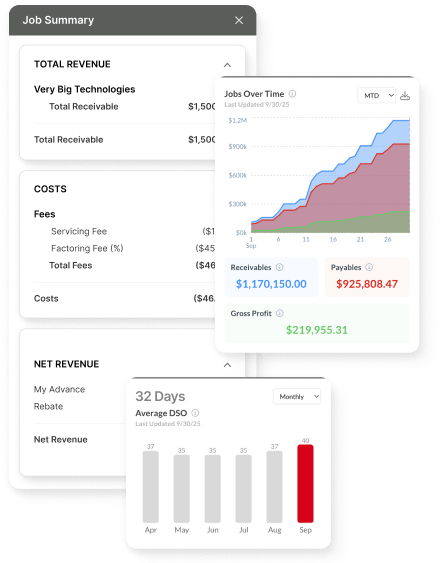
Integrating Broker Factoring into their TMS let Yeti start a job payment right from their existing dashboard, with load information sending over on its own. The integration cut out the redundant entry that used to eat up their mornings, and the team only needs to open the platform now for exception management.
The time savings showed up fast. In one stretch, the team closed out 19 loads in about an hour — roughly three minutes a load, a 75% drop in time spent on back-office work. “The more we can do without leaving one screen, the faster we move,” said James.
Money saved without long-term contracts
Yeti factors 80 to 85% of its loads through Broker Factoring. For the rest, the team self-funds using its own capital, running the same workflow and automation either way so nothing about the process changes depending on how a load gets paid. That flexibility is a shift from Yeti’s old contract, which required factoring every load regardless of how quickly a customer paid.
Splitting loads between factoring and self-funding saved the company close to $20,000 a year — savings that matter more in a slower freight market where every cost gets scrutinized.
Based on our factoring expenses from last year, switching led to an 18 percent reduction in costs.”
Hiring without exposing sensitive data
James had avoided hiring dedicated accounting help for years. Bringing someone on meant handing over access to carrier payments and financial records, and until now, that wasn’t a risk he was willing to take with a team of three.
Role-based permissions on the platform changed that. James can bring someone in to manage the books without giving them the run of everything else — the first time he’s felt comfortable making that hire.
Built to keep growing
James and Alison aren’t done scaling. Growing Yeti Logistics from a three-person team into a bigger brokerage is still the goal, and now the back office has room to keep pace with that growth instead of holding it back.
Yeti Logistics built its business on relationships, not just rates, and that hasn’t changed. What’s changed is how much time the team gets back to spend on those relationships instead of paperwork.
If your brokerage is factoring under a contract that doesn’t flex with your business, or a system that doesn’t talk to the tools you already use, see what Broker Factoring from Truckstop Financial could do for your back office.



Get helpful content delivered to your inbox.
Spend less time on invoices and more time moving freight.
See how Broker Factoring from Truckstop Financial handles your AP/AR, pays carriers fast, and gives you the financial visibility to grow with confidence.














.png)

.png)

