

What to ask a factoring company before you hand over your invoices

Stop chasing invoices.
Access your capital in 24-48 hours and keep freight moving.
Choosing a factoring company is one of the bigger decisions a freight brokerage makes. The company you pick touches your cash flow, how fast your carriers get paid, and how your collections run. Pick the wrong one and the cost shows up as chargebacks, slow carrier pay, and hours lost to a support line that never picks up.
Freight has been a hard market to price and cover, and thin margins leave little room for a financial partner that stumbles. Factoring companies can and do fail, and the brokers who relied on one are left exposed fast when it happens.
The questions below are the ones worth asking before you sign, each with why it matters and how Broker Factoring from Truckstop Financial answers it. Factoring bridges the gap between paying carriers in days and collecting from shippers in weeks, and the mechanics of how broker factoring works go deeper than one checklist can hold.
What is the factoring rate?
The factoring rate is usually a percentage of the invoice, so it comes straight out of margin on every load you factor. The rate is a common comparison point when brokers weigh factoring companies, but it does not tell the whole story. Look at the full package too, including flexibility, automation tools, and any added fees.
Truckstop: Broker Factoring rates depend on your brokerage’s size and volume, and typically fall between 1 and 2 percent.
You can also lower what your capital costs. Flexible Factoring drops your rate when you delay your own payment or the carrier’s, and the savings grow when a shipper pays faster than 30 days.
Are there any fees outside the factoring rate?
Factoring fees are often hidden, and the rate on its own rarely reflects the full cost of your capital. Asking a factoring company straight out for a list of every fee outside the rate gives you a clearer view of what you will actually pay.
Common ones to ask about include ACH fees, minimum fees, QuickPay fees, and setup fees.
Truckstop: Broker Factoring charges a small per job fee, typically $1 but varies based on agreement. There are no ACH fees, no admin fee, and no hidden charges, so the cost is easy to predict from one invoice to the next.
How fast do your carriers get paid?
Your carriers keep your freight moving, so paying them fast keeps them hauling your loads and covering last-minute freight. A short days-to-pay strengthens carrier relationships and makes sourcing easier.
A factoring company should pay your carriers before you collect from the shipper, so you are not fronting capital while you wait to get paid, and you are not fielding payment calls all day.
Truckstop: QuickPay is free to run on every job, so your carriers get paid within one to two business days at no cost to you.
Some carriers want their money sooner to cover fuel and other costs on the road. For those loads, Broker Factoring offers Express Factoring, where a carrier can pull their payment forward within minutes for a small fee, including nights and weekends.
Carriers choose Express Factoring themselves, so there is nothing for you to set up, and near-instant pay becomes one more reason for a carrier to run your freight.
Does the factor take a cut of QuickPay fees?
Paying carriers fast is a selling point, and many factors treat the QuickPay fee as shared revenue, taking a percentage of what the carrier pays for the speed.
Truckstop: There is no revenue share on QuickPay here. The broker sets the terms, charging carriers for QuickPay or offering it free to win loads, and keeps whatever it decides to charge. That makes QuickPay a tool the broker controls and an additional revenue stream. One Broker Factoring customer made $60,000 a year in additional revenue from QuickPay fees.
How do you know when you will get paid, or if a job is approved?
Guessing when a payment will hit your account makes it hard to know whether you can take on a big new contract today. A factoring company with clear payment tracking and financial analytics gives you what you need to make better calls and stay on top of cash flow.
Truckstop: The Truckstop Financial online portal shows where each job stands, along with carrier and shipper payment timing and what has cleared, so your cash position is visible without a phone call.
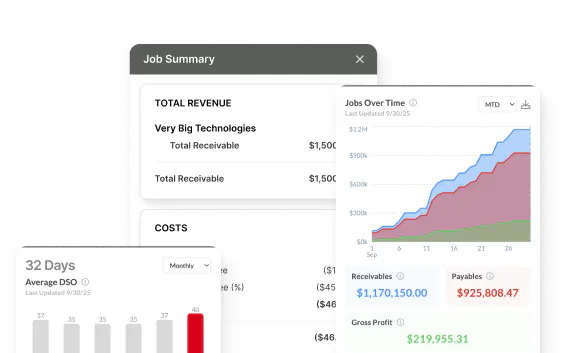
The homepage gives you a snapshot of your financial health, with your AP, AR, and a forecast of what is coming. You can also see your fastest-paying shippers and your most-used carriers, which helps you decide where to lean when a large contract is on the table.
Is it recourse or non-recourse factoring?
The difference between recourse vs. non-recourse comes down to who takes the loss when a shipper does not pay, which is the single biggest risk in the factoring arrangement.
With recourse factoring, you buy back any invoice the factoring company cannot collect, so the risk stays with you. With non-recourse, the factoring company absorbs that loss, though usually only when a shipper cannot pay for credit reasons, not in a billing dispute. Knowing which one you are signing tells you exactly how much of the payment risk is yours.
Truckstop: Broker Factoring is recourse only, which means the broker stays responsible for an invoice the factoring company cannot collect on. Due to carrying more of the risk, you get a lower rate.
To support broker clients, Broker Factoring runs a credit check on every shipper before you factor their loads, so both parties understand the exposure before moving forward.
How long do shipper credit checks take?
Speed matters most with a new shipper. You want to know fast whether their loads are factorable, because waiting more than a day can cost you the job or strain the relationship before it gets going.
Truckstop: Every shipper runs through a credit check, so you factor loads for customers likely to pay. Approvals usually come through within one business day, and often the same day, so a new shipper is not stuck waiting while freight sits.
If a shipper does not pass, you get told why, with a chance to send more information and make the approval work.
For a growing brokerage, fast approvals can be the difference between booking a new shipper and losing one. After moving its back-office in house, Alliance Logistix called Truckstop’s credit approvals fair and fast.
Does it connect with your TMS?
If your team already runs a TMS, a factoring company that does not connect means keying the same job data twice, once in your system and again in theirs. Every rekey slows down your back-office team and opens the door to a wrong number or a missed load. At volume, those small errors turn into disputes and delays.
Truckstop: Broker Factoring connects with more than 18 transportation management systems, so job and invoice data flows through without double entry.
From inside your TMS, sending a job to factoring takes a single click, which creates the job for approval in your Truckstop portal. Once you submit a load, Truckstop pushes the details back to your TMS, so payment updates show up in the system your team already works in.
The two-way flow keeps your back-office in one place instead of spread across tools. After connecting Tai Software to Broker Factoring, Encounter Logistics cut the time to bill a load from two or three hours to under five minutes, a 91 percent drop.
How does the factor audit your paperwork?
A freight bill audit is the review that catches a wrong amount or a missing document before the invoice reaches the shipper, and a slow one holds up your funding.
Truckstop: When you submit a load for funding, a feature called Document Audit compares your uploaded documents against the job details and flags anything that does not match, like a wrong amount, a missing document, or an off reference number. You see what to fix right in the app, so the job moves ahead instead of bouncing back for a correction.
Is there a dedicated account manager?
Setup is where most factoring headaches start, and a real person to call beats a ticket queue when a payment is stuck.
Truckstop: Every broker gets a dedicated account manager who helps with setup and is available for questions and account reviews.
Can you control how collections reach your shippers?
Collections outreach reaches your shipper’s inbox, so a generic reminder from an unfamiliar sender can confuse customers, slow payment, and reflect on you.
Handing collections to a factoring company is where it can go sideways. Some chase your shippers with repeated calls and emails, follow up on invoices that were already paid, or use a harder tone than you ever would with a customer. The shipper feels the pressure, and the relationship you built is the one that suffers.
Truckstop: Collections are customizable, so outreach can carry your name and tone instead of Truckstop’s. You set the timing, the frequency, and who gets reminders for each shipper, and shippers get a self-serve view of open invoices and payment status. Truckstop Financial does the work in the background while you keep control of the relationship.
Walk in with your questions ready
A factoring company is a long partner, not a quick sign-up, so the questions you ask before you commit shape the years that follow. The rate is only the starting point.
What sets one factoring company apart is the rest of the package: how fast your carriers get paid, how quickly a new shipper clears credit, whether it connects to your TMS, and how collections treat the customers you worked to win. Ask those up front, and you will know what you are getting before you commit.
Every one of these questions has a clear answer with Broker Factoring from Truckstop Financial.




Get helpful content delivered to your inbox.
Fund carrier payments without the wait
Pay carriers fast and maintain relationships without waiting on shippers’ 30-day terms.





.png)

.png)

