

Using AI to modernize fleet maintenance and improve profitability
Listen up!
Check out our podcast, Behind the Freight, where industry experts talk all things trucking.
Maintenance is a topic that only comes up when something goes wrong. It is often viewed as a necessary evil or a hidden cost that is difficult to control.
But when you wait until a truck is broken down on the side of the road to think about a repair strategy, you have already lost the battle.
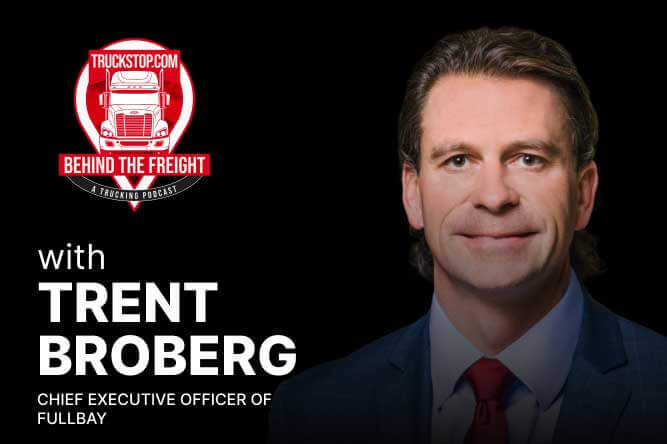
In a recent episode of Behind the Freight, Todd Waldron and John Howland sat down with Trent Broberg, CEO of Fullbay. Trent has spent over twenty years in the industry, from sleeping in trucks at Swift Transportation to leading major logistics technology companies.
He shared why fleet profitability today depends on data and communication just as much as it depends on better engines.
Access the full episode of Behind the Freight:
The truth about the truck usage shortage
One of the biggest talking points in trucking is the driver shortage. Trent views this differently based on his decades of experience.
“It’s not a driver shortage. It’s a utilization shortage,” he says. While drivers have an eleven-hour clock, the data shows that the average truck is only utilized for about seven and a half hours.
That adds up to a lot of wasted time every day. If a carrier can get a driver to use even thirty more minutes of their logbook, the running costs of that business improve fast. Most fleets can find that gap by pulling usage data from their ELDs.
Improving maintenance is one of the fastest ways to reclaim those lost hours by keeping drivers on the road instead of waiting at motels for repairs.
Why you must manage profit at the asset level
Many trucking companies manage their profit and loss statements (P&L) at the fleet level. This approach can hide serious problems with individual pieces of equipment and makes it hard to see the cost per mile on each truck.
“Each truck is different. A lot of people are not managing the cost structures per asset,” Trent says. Age, powertrain, and mileage all change the math from one truck to the next.
To see your real profitability, you have to look at revenue and costs for every individual asset. That is also where the true cost of downtime shows up.
If a truck that typically generates $800 to $1,600 a day in revenue sits in a shop for three days, you aren’t just paying for the repair, you are losing thousands of dollars in potential earnings.
Tracking at the asset level helps you catch problem before they get worse instead of reacting to them on the side of the road.
The shift to AI and predictive maintenance
The industry is currently moving away from reactive repairs toward a predictive model. Fullbay recently acquired a company called Pit Stop to integrate AI models that can understand when a part is likely to fail before it actually breaks.
Using ten years of historical data from thousands of repair shops, these tools can provide a “red, yellow, green” status for every truck in a fleet.
This technology uses sensor data and vehicle tracking technology to catch issues while the truck is still in the shop for a routine check. It is one of several places where AI is now reshaping the freight industry.
Catching a problem early is always cheaper than dealing with a roadside breakdown that requires a tow, a transload, and emergency repair fees.
While autonomous trucks may still be years away, AI-driven maintenance is here now and changing how shops operate.
Communication and the value of predictability
The relationship between a carrier and a repair shop is built on communication. Trent points out that in logistics, predictability is often more important than pure speed.
Most operators can handle a two-day delay if they know about it ahead of time. The real frustration happens when two days pass with no updates at all.
“Bad news is better than no news. Bad news sounds better early,” Trent says.
When you have accurate data and early communication, you can make informed business decisions, such as pulling a different trailer or rescheduling a load. Without that data, you cannot manage your business effectively.
How to start your maintenance strategy
For smaller fleets or owner-operators, the idea of AI and “predictive models” can feel overwhelming. Trent suggests a simple approach: start with the 80% mentality.
You do not have to solve every single problem on day one.
The first step is simply to start tracking your data. Even an Excel spreadsheet is a great starting point for recording expenses per asset.
Once you understand what your operating costs are for each truck, you can begin to see the patterns that lead to better profitability. Kevin Rutherford made the same point in an earlier episode on owner-operator profitability: operators who don’t know their numbers are guessing.
By focusing on the basics of data and communication, any carrier can start to modernize their maintenance and keep their wheels turning and earning.
Reclaim the time your trucks are losing
Maintenance is one of the drivers that decides whether each truck runs at a profit or a loss. Start by tracking expenses per asset, even in a spreadsheet.
Move toward predictive tools when you are ready. And when something does go wrong, share the news early.
When you know what each truck costs to run, you can pick loads that protect your margin. The Truckstop Load Board gives carriers the rate and lane data to find work that clears your cost per truck.
Listen to the full conversation with Trent Broberg for more on heavy-duty repair and fleet efficiency.




Get helpful content delivered to your inbox.
Sign up today.
Find high-quality loads fast, get higher rates on every haul, and access tools that make your job easier at every turn.






.png)

.png)

