

What owner-operators are missing when it comes to profitability
Listen up!
Check out our trucking podcast, Behind the Freight.
The trucking industry often gets explained through freight data, rates, capacity, and market cycles but they don’t tell you in brass tacks how to run a profitable truck.
Behind every load is a set of decisions like what load to take and what it costs to run it. Those decisions decide whether a business makes money or not.
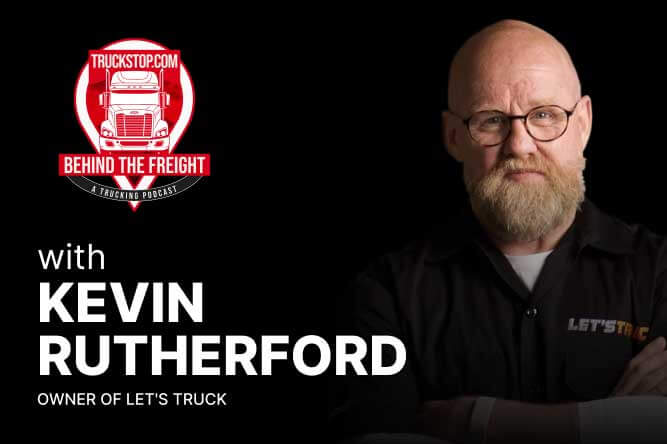
That came through clearly in a recent conversation on Behind the Freight, where Todd Waldron and John Howland spoke with Kevin Rutherford at the Mid America Trucking Show.
Access the full episode of Behind the Freight:
It starts with knowing your numbers
A lot of operators don’t have a clear handle on their cost per mile.
They know what they’re getting paid on a load but they don’t always know what it costs them to run it. Without that number, it’s hard to tell if you’re making money or just staying busy.
“If you don’t know your cost per mile, you’re guessing,” said Kevin Rutherford, founder of Let’s Truck.
Start here: add up your fixed costs, truck payment, insurance, permits, and divide by the miles you run each month. Then layer in your variable costs, fuel, tires, maintenance. That gives you a baseline. If the rate on a load doesn’t clear that number, you’re not making money on it, no matter how it feels in the moment.
Everything flows from this. Decisions like the loads you accept, the lanes you run, and the way you bill your time. When you know your numbers, all these decisions get sharper.
Fuel is one of your biggest costs
Fuel hits your bottom line every single day, and you have more control over it than most operators realize. For most owner-operators, diesel accounts for somewhere between 20 and 30 percent of total operating costs. When prices spike, those margins compress fast.
“Fuel is one of the biggest expenses, and you control more of it than you think,” said Kevin Rutherford.
Monitoring idle time, adjusting speed, and being strategic about where and when you stop are habits that compound over thousands of miles. How fuel pricing affects your load decisions is part of knowing whether a load actually pencils out before you accept it.
Adding trucks changes the game
Going from one truck to two becomes a different kind of business entirely. Now you’re managing a fleet, people, schedules, and more moving parts. The level of control you had before starts to change.
“The second truck is where things get hard,” said Kevin Rutherford.
This is where a lot of operators run into trouble. What worked with one truck doesn’t always hold up when things expand. Before adding equipment, it’s worth asking:
- Is my current operation consistently profitable?
- Do I have the systems in place to manage more complexity?
- Am I solving a problem or growing into one?
Growth is only an advantage if the foundation is solid.
Driving skill and business skill are not the same
Experience on the road doesn’t automatically translate into running a profitable operation.
“Being a good driver doesn’t mean you’re running a good business,” said Kevin Rutherford.
Driving safely and efficiently is the baseline. But running the business means understanding costs, managing cash flow, and making decisions based on numbers. A driver who knows their lanes but doesn’t know their cost per mile or have a profit and loss document is working hard without full information.
The operators who build stable businesses tend to treat the financial side with the same seriousness as the operational side.
Doing all of this well separates staying afloat from building a stable business.
Mindset in the business
Some operators treat their operation like a business they are responsible for. They track performance, adjust when needed, and stay focused on what they can control.
And others look outward when things don’t work. Blaming rates, brokers, or the market.
The market is real. Rates do fluctuate. But operators who focus on what they can control — their costs, their decisions, their habits — tend to find more consistency over time. The approach you take shapes the results you get.
Owner-Operator profitability starts here
Trucking is shaped by a mix of market forces and day-to-day decisions. Some things really are out of your control.
But a large part of the outcome comes down to how the business is run. It’s important to know your numbers, manage your biggest costs, and make decisions with intent. Those three things won’t eliminate the hard stretches, but they’ll put you in a better position to weather them.
Listen now to build a more stable business.




Get helpful content delivered to your inbox.
Sign up today.
Find high-quality loads fast, get higher rates on every haul, and access tools that make your job easier at every turn.






.png)

.png)

