

How Much Do Long-Haul Truck Drivers Make? OTR Pay Breakdown
Experience
Unmatched Security
Help protect your business with the load board you can trust.
How much do long-haul truck drivers make? Most OTR drivers earn between $60,000 and $90,000 a year, with entry-level pay starting near $45,000 and top specialized earners crossing $100,000.
The number that ends up in a driver’s pocket depends on several variables: experience, freight type, lane, equipment, and whether the driver runs as a company employee or under their own authority.
This guide breaks down what long-haul pay actually looks like today, with state and freight-type ranges, per-mile tiers, and the ways drivers raise their income from year to year. Carriers ready to skip ahead can check live freight on the Truckstop Load Board for carriers.
How much do long-haul truck drivers make per year?
Long-haul (OTR) truck drivers earn an average of $65,000 to $90,000 per year, with entry-level pay starting around $45,000 and top specialized earners exceeding $100,000.
According to the most recent Bureau of Labor Statistics data, the median annual wage for heavy and tractor-trailer truck drivers was $58,640 in May 2025, up from $57,440 the prior year. The bottom 10% earned less than $40,140, and the top 10% earned more than $79,380. OTR-specific roles tend to skew higher because of the mileage volume.
ZipRecruiter places the average long-haul company driver salary at $71,196 a year as of May 2026, with experienced drivers earning $90,500 or more. ZipRecruiter figures reflect job posting data, not reported earnings, so they tend to run higher than survey-based sources.
The pay split also depends on whether a driver runs as a company employee or as an owner-operator.
W-2 long-haul drivers
Company drivers get a paycheck on a regular schedule. ZipRecruiter pegs the national average for a long-haul company driver at $71,196 annually, with entry-level positions starting as low as $23,500 and experienced drivers earning $100,000 or more depending on lane and equipment.
The advantage is predictability. The trade-off is a ceiling. Most W-2 drivers max out somewhere around the top 10% range unless they move into specialized freight or take on team driving.
1099 owner-operators
Owner-operators who lease or run under their own authority sit in a different income tier. ZipRecruiter shows the average owner-operator truck driver grossing around $228,575 annually as of May 2026, with OTR owner-operators averaging $260,732 gross.
The gross number looks impressive, but it does not reflect take-home pay. Owner-operators cover fuel, maintenance, insurance, permits, tolls, and truck payments before anything lands in their account. After expenses, net income for owner-operators typically falls in the $80,000 to $150,000 range, depending on lane discipline, fuel efficiency, and broker quality.
Long-haul truck driver salary by state
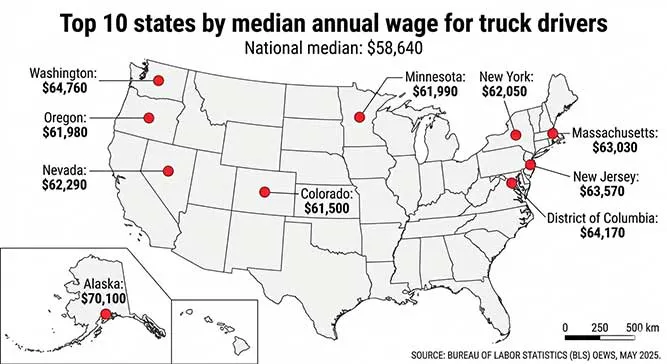
The highest-paying states for long-haul drivers in 2025 are concentrated in the Northeast, the Pacific Northwest, and parts of the Mountain West, where freight demand outpaces local driver supply. Median wages below come from the BLS Occupational Employment and Wage Statistics (OEWS), May 2025 release.
| State | Median annual wage (BLS OEWS, May 2025) |
|---|---|
| Alaska | $70,100 |
| Washington | $64,760 |
| District of Columbia | $64,170 |
| New Jersey | $63,570 |
| Massachusetts | $63,030 |
| Nevada | $62,290 |
| New York | $62,050 |
| Minnesota | $61,980 |
| Oregon | $61,980 |
| Colorado | $61,500 |
| National median (heavy and tractor-trailer) | $58,640 |
State pay differences come down to two factors: cost of living and lane density. States with major freight corridors and high outbound demand pay more to keep trucks moving. States with lower freight density and lower local wages sit closer to the bottom of the range.
Long-haul driver salary by freight type
Freight type changes the math at every experience level. Specialized equipment, endorsements, and the willingness to handle complex loads all pull pay upward. Ranges below reflect industry compensation data averaged across ZipRecruiter, Indeed, and industry data.
| Freight type | Company driver (annual) | Owner-operator (annual gross) |
|---|---|---|
| Dry van | $58,000 – $72,000 | $130,000 – $160,000 |
| Reefer | $62,000 – $80,000 | $140,000 – $175,000 |
| Flatbed | $65,000 – $80,000 | $150,000 – $180,000 |
| Tanker (with endorsement) | $70,000 – $95,000 | $160,000 – $200,000 |
| Hazmat (combined endorsements) | $75,000 – $110,000+ | $170,000 – $220,000 |
Dry van runs sit at the entry tier because the freight is the most common and the carrier base is the largest. Reefer adds equipment skill and temperature compliance. Flatbed adds load securement and physical work. Tanker and hazmat add risk and regulatory complexity, which is why the pay climbs with each layer of endorsement.
Long-haul vs. short-haul driver salaries
Long-haul trucking covers routes over 250 miles, often crossing several states in a single run. Short-haul trucking covers routes under 250 miles and usually keeps drivers in a regional or local footprint.
Long-haul drivers usually earn more per year because the mileage volume is higher and the freight tends to involve longer contracts and steadier load patterns. Regional drivers earn slightly less than long-haul averages but get home weekly, which appeals to drivers with families. Local drivers earn the least per mile but can stack loads efficiently and avoid the lifestyle costs of OTR work.
For drivers picking between long-haul and short-haul, the income gap is often smaller than the lifestyle gap.
Load vs. mile pay for truck drivers
Most OTR drivers get paid one of three ways: by salary, by percentage of the load, or by the mile.
Percentage pay can range from 25% to 85% of a load’s value and works well for high-revenue freight, but it is harder to predict week over week. Salaried positions exist but are less common in OTR work. Mileage pay is the most common structure and the easiest to compare across carriers.
CPM (cents per mile) rates vary by experience, equipment, and freight type. Here is what the current market looks like:
| Experience tier | Typical CPM range |
|---|---|
| Entry (0–12 months) | $0.40 – $0.50 / mile |
| Mid-career (1–3 years) | $0.52 – $0.62 / mile |
| Experienced (3–5+ years) | $0.60 – $0.70+ / mile |
| Specialized / premium (hazmat, tanker, oversized) | $0.70 – $0.85+ / mile |
CPM is one part of the equation. The other part is how much each mile actually puts in the driver’s pocket after deadhead, idle time, and fuel. Owner-operators evaluating a lane before they accept can run the rate against current market data using Truckstop Rate Insights to see whether the posted rate sits above or below what brokers paid recently for that lane and equipment.
5 ways long-haul drivers can increase their pay
Pay is not fixed. The drivers who move up the income ladder tend to do some combination of the following five things.
1. Reduce deadhead miles
Deadhead miles are the part of lane selection most drivers underestimate. A load paying $2.50 per mile looks worse than a $2.10 load with a guaranteed reload 40 miles out. Most drivers never see the second load until they’re already empty and hunting.
The Truckstop Load Board‘s Backhaul Search flips your origin and destination with one click, so you can search for return loads from your drop point before you’ve even backed into the dock.
2. Move specialized freight
Endorsements are the fastest way to lift CPM without changing carriers. A hazmat endorsement opens chemical, fuel, and explosive freight. A tanker endorsement opens liquid bulk, including food-grade and chemical loads. Doubles, triples, and oversized add more lift on top of that.
Each endorsement requires a test, sometimes a background check, and a small fee. The income lift typically pays back the cost within the first few months.
3. Run as an owner-operator under your own authority
Owning the truck and the authority means keeping a larger share of every load.
The tradeoff is real overhead: fuel, maintenance, insurance, permits, and back-office work all come out of your pocket before anything lands in your account.
Drivers who make it past the first year tend to share three habits: tight expense tracking, disciplined lane selection, and a back-office system that handles invoicing and IFTA without eating their weekends. Getting your trucking authority is the first step toward keeping more of what you earn.
4. Negotiate dedicated lanes or contract freight
Spot freight income swings with the market. Dedicated freight pays a fixed rate on predictable volume, which means more predictable cash flow, easier trip planning, and less time on the load board each week.
Drivers that invest in broker and shipper relationships can lock in consistent lanes before the spot market gives them a reason to. Consistent on-time performance and reliable communication are what move you from the spot pool to a broker’s preferred carrier list.
5. Cut cost per mile
The other side of higher pay is lower cost. Fuel discounts, expense management, and getting paid sooner all push take-home up.
Owner-operators waiting 30 or 45 days to get paid after delivery can lose hundreds of dollars per load in cash-flow drag.
Truckstop Factoring advances payment on broker invoices in one day with a flat fee and no annual contract, so freight factoring becomes a working-capital tool rather than a last resort. Combined with smart fuel buying and lane selection, drivers can also build a list of high-paying truck loads to chase consistently.
When do you get paid as a long-haul truck driver?
Company drivers get paid on the carrier’s schedule, usually weekly or biweekly.
Owner-operators get paid when brokers pay, which can be 15, 30, or even 60 days after delivery. Fuel and maintenance don’t wait that long.
Freight factoring bridges that gap by advancing payment on a delivered load for a flat fee, so cash flow stays steady between broker payments.
What is the job outlook for long-haul truck drivers?
The BLS projects 4% growth for heavy and tractor-trailer truck drivers from 2024 to 2034, with about 237,600 openings expected each year from a combination of growth and replacement demand.
Trucking moves the majority of freight in the United States, and as freight volume grows alongside consumer demand, OTR drivers should continue to see consistent work year-round.
Book higher-paying long-haul loads
Long-haul pay comes down to lane choice, freight type, and how fast the driver can find the next load after delivery. Drivers who plan reloads before they unload, check broker payment history before booking, and run rates against current market data tend to land in the upper half of every income range above.
The Truckstop Load Board brings verified broker loads, lane-level rate data, factorability visibility, and reload search into one workflow, so drivers spend less time on the phone and more time earning miles.
Frequently Asked Questions




Get helpful content delivered to your inbox.
Sign up today.
Find high-quality loads fast, get higher rates on every haul, and access tools that make your job easier at every turn.






.png)

.png)

