

What you can and can’t share when brokers request ELD data

What are you waiting for?
Get our powerful TMS for brokers and carriers alike.
The trucking industry is becoming more digital by the day. Electronic logging devices (ELDs) are important for providing hours of service (HOS) and can make operations safer. As more brokers rely on ELD data to vet carriers and plan loads, choosing the right ELD system matters not just for compliance, but for how easily you can control what data is shared and with whom.
Brokers need HOS information to make sure loads are delivered on time and legally. Still, it’s important to know what ELD data you can and can’t share with brokers. For instance, you should always protect sensitive personal information and business data.
Here, we’ll discuss the required ELD data for brokers as well as information you don’t have to share. With this information, you can better leverage ELDs to improve your business while still protecting it.
Required data you must share with brokers
Carriers are only required to share data that verifies HOS compliance on a specific load the broker is arranging. This means you aren’t required to provide brokers with all of your ELD data, but you must share supporting documents about your HOS. The Federal Motor Carrier Safety Administration (FMCSA) mandates this standard for compliance and safety.
Brokers can request ELD logs to ensure they’re hiring compliant, capable carriers. After all, an HOS violation could cause delays and issues for all involved. Here’s the data you’re required to share with brokers:
HOS supporting documents
You’re only obligated to share supporting documents to prove HOS compliance. The ELD’s output file will contain the driver’s HOS logs for the specified date range and time. It will also show the nearest city, town, or village name, engine hours, and vehicle miles. Brokers need to see the driver’s current available driving and on-duty time. This helps them confirm the driver has enough available hours to complete a load legally and on time.
Driver’s name and carrier’s DOT number
You must share the driver’s name and the carrier’s U.S. Department of Transportation (DOT) number with brokers. The broker needs this information to identify the driver and company for their records.

Secure ways to share HOS data
You can securely share HOS data with brokers in any of these ways:
- Screenshot: The safest and easiest way to share your HOS data is with a screenshot showing the driver’s name and available hours.
- Email/PDF export: Export a single-day log or a summary page as a PDF and safely email it to the broker. This way, you provide the formal record they need without giving away historical data.
- Secure third-party services: Some platforms allow secure, limited sharing of HOS data. However, always double-check the exact information being transmitted. Make sure you’re only sharing what’s necessary.
ELD data you shouldn’t share with brokers
The FMCSA mandates ELDs for recording HOS, but doesn’t require carriers to give brokers direct access to the system. The rules are designed to make operations safer rather than giving brokers oversight of a carrier’s entire operation. Broker ELD information requirements are limited to the specific load they’re arranging, nothing more.
Many carriers assume brokers are entitled to more ELD access than they actually are, often because of outdated assumptions or misinformation. Common ELD myths can blur the line between compliance and over-sharing, which is why it is important to understand what the rules really require.
Below are some ELD data sharing limitations. Withholding this information is important to protect your privacy and security.
Specific address and driving history
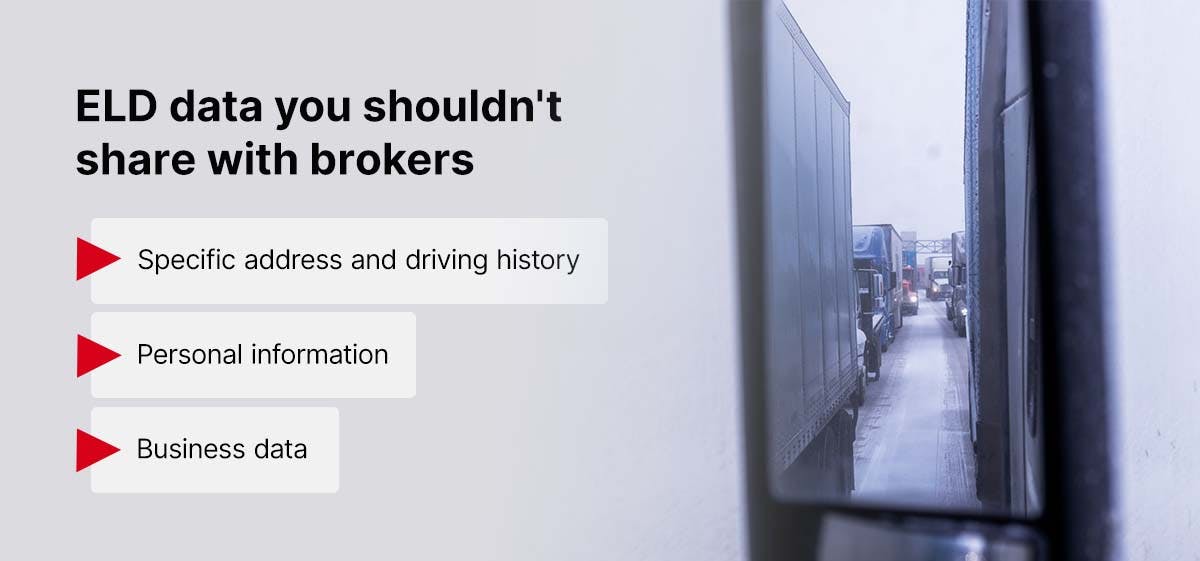
Avoid sharing continuous GPS tracking data with brokers. You aren’t required to give them specific street addresses. Instead, use your ELD to provide the nearest city, town, or village. Also, you don’t need to give brokers a complete history of a driver’s movements. This information is proprietary and irrelevant to verifying HOS for a single load.
For example, say a broker asks about a specific past load, looking for ELD data on a previous trip to investigate a detention claim. As a carrier, you only need to share the specific log from the day in question, not your entire history.
When disputes arise over what should or shouldn’t be shared, understanding how ELDs can protect carriers can make a big difference, so here’s a closer look at how ELDs help carriers in disputes.
Personal information
You do not need to share personal information with brokers. Avoid sharing the driver’s license number, Social Security number, or phone number. This is all sensitive and not relevant to meeting HOS compliance.
Additionally, while the ELD tracks location, you don’t need to disclose frequent personal stops or the driver’s home address. Sharing this information could pose a risk to privacy and security.
Business data
Avoid giving brokers sensitive information that could compromise your security, such as login credentials. Also, don’t share detailed logs from past trips or engine performance data, as this could be collected and misused by brokers or shippers. For instance, they could use the data to figure out your operational patterns and use it against you in rate negotiations.
How to handle broker information requests
Here are some tips for handling broker information requests to streamline this process:
- Establish a clear communication protocol: Carriers should come up with a standard way to handle data requests. For example, you might designate a point of contact and consistently use the same method to share information. This way, only the required information reaches the broker.
- Respond to requests professionally: When responding to requests, be professional when declining too much information. For example, you might say something like, “I can confirm our driver has the required HOS with a screenshot of their current availability. However, for security and privacy purposes, we don’t provide direct access to our ELD system.” Or, say a broker asks for continuous tracking. You can politely decline and let them know that periodic check-ins are your policy, not continuous tracking. Explain that this would reveal proprietary business information beyond what’s needed on that single load.
- Set expectations in your carrier packet: Create a brief statement about your data-sharing policy for brokers. Include it in your new broker packet or rate confirmations. This can specify how you’ll provide HOS data to confirm compliance, but won’t offer direct ELD access for security reasons. This is a proactive step you can take to show your professionalism from the start. It can help you prevent misunderstandings or unreasonable requests from happening in the first place.
When ELD data is organized and used intentionally, it can support more than compliance. Using ELD data to improve efficiency helps carriers respond to broker requests faster while keeping internal processes consistent.

Find trusted partners with Truckstop
ELDs are necessary. They make your operations smoother and help you comply with the FMCSA. While brokers need essential HOS data, it’s important to note what you should and shouldn’t share from your ELDs. Always withhold your sensitive personal and business data, and only provide specific HOS data that’s required from you.
When it comes to ELD data security, you need a trustworthy partner who can protect your information and improve your operations. That’s where the Truckstop Load Board comes in. Our platform allows carriers to connect only with vetted, professional brokers. This way, you build relationships with those who understand and respect industry regulations. Additionally, RMIS Carrier Onboarding provides secure, consent-based data sharing with brokers.
Our platform uses anonymized data for shipper visibility. This means only the required information is shared, and with your explicit consent. Build a trusted network while negotiating higher rates on every haul. Get started today to see the difference.



Get helpful content delivered to your inbox.
Sign up today.
Find high-quality loads fast, get higher rates on every haul, and access tools that make your job easier at every turn.






.png)

.png)

