

10 must-know bookkeeping tips for truckers

Run your whole operation from one place.
One powerful TMS for brokers and carriers.
Receipts in the door pocket, invoices in your email, and mileage in your head all land on the same day at tax time. Bookkeeping for truckers comes down to one habit, recording every dollar when it moves.
These 10 tips cover receipts, accounts, records, and software, whether you hire a bookkeeper or do it yourself.
1. Save every receipt (even for small purchases)
You want to be able to deduct as many legitimate costs as possible. Keep an envelope in your truck for collecting receipts, or use the dedicated folders on your computer or in a cloud for e-receipts. Use this information to track your monthly profit-and-loss statements and accurate quarterly tax estimates.
Scanned images of receipts are acceptable, but be sure to keep the original paper copies for any big-ticket items you purchase, as they may be needed for warranty purposes.
2. Open a separate checking account for your trucking business
As a self-employed truck driver, it’s important to keep your personal and business expenses separate. Deposit business payments into your business account, then pay yourself from that account. This makes it much easier to track and separate your business expenses.
3. Use a separate credit card for business expenses
Research credit cards available for trucking industry professionals.
Look for things like:
- Cash back on purchases
- No annual fees
- Fuel cards that simplify accounting and offer advanced security
Pay the balance in full every month to avoid racking up additional business debt.
4. Save all of your logbooks
Your electronic log devices (ELDs) are your best proof of entitlement to per diem expenses and record of your drive time, breaks, and miles driven. You will need this information for inspections, too.
The best ELDs can record and report the following:
- Miles
- Engine hours
- Duty status
- Time and date
- Location
5. Keep a running tally
For accurate bookkeeping, trucking companies must track the date, location, amount, and reason for each expense to meet tax obligations and comply with IRS regulations.
Document all expenses and time spent on your business operations on your computer or smartphone to cross-reference the receipts you have or any you can’t obtain. This includes things like washing your truck at a coin-operated facility or recording mileage for business use of your personal vehicle. Provide a monthly record and any other receipts to your business services provider or tax accountant if applicable.
6. Save your records
Keep the records behind your tax return for at least three years from the filing date (the due date, if you filed early). Keep records on your truck and trailer until the limitations period runs out for the year you sell them. If you pay employees, keep employment tax records at least four years.
You should also keep all IRS quarterly estimated tax payments, monthly profit and loss statements, insurance documentation, maintenance records, warranty information (which should be available immediately to keep your truck on the road), registration information, bank statements, trucking business credit card statements, and canceled checks.
7. Use trucking accounting software
Trucking bookkeeping and tax preparation are easier if you use consistent accounting systems and practices. Most trucking businesses use either a cash-based or accrual-based accounting method.
With cash-based accounting, you record income only when you receive payment and expenses only when you pay bills. This is the most straightforward system to ensure you keep track of everything accurately.
With an accrual-based system, you record revenue when it’s earned (before you receive payment) and expenses when they’re incurred (before you pay them). Each month, you reconcile accounts to ensure they match up accurately.
8. Review your finances frequently
Electronic invoicing and payments make getting paid simpler. Check your bank account against your open invoices every week so you catch a short payment or missing deposit early.
Check expenses to your bank accounts to make sure they are legitimate expenses, especially if you’re not the only one with access to the account.
If there is a discrepancy, you want to catch it quickly before it becomes a bigger problem for your trucking business.
9. Do a month-end close
A best practice for bookkeeping for truckers is to make sure you close out each month by making sure you have all of your documentation, it matches your records, and you can tie revenue and expenses accurately to the balance at the end of the month.
10. Make sure your books are audit-proof
If the IRS ever audits your return, organized records make the process far easier. Have these ready:
- Documented and organized financial records.
- Accurate mileage and expense logs.
- Properly reported income and deductions.
- Compliance with tax regulations and receipts for expenses.
How to simplify recordkeeping
To simplify your recordkeeping as an owner-operator, whether you use paper or electronic methods, consider the following approach:
Organize with an expanding file folder
- Purchase an expanding file folder and label the pockets for different expense and income categories (e.g., maintenance, fuel, meals, equipment).
- Drop receipts into the corresponding pocket as you receive them to prevent accumulation.
Daily maintenance
- Make a habit of filing receipts daily to avoid a backlog.
Monthly consolidation
- At the end of each month, total up the receipts in each pocket.
Utilize a desktop calculator
- Label the calculator’s register tape with the month and year.
- Staple the tape to the corresponding stack of receipts to keep everything organized.
Odometer tracking
- Note your odometer reading at the beginning of each month to track your true cost per mile.
- Record odometer readings at the start of each new load for more precise cost per mile calculations.
This straightforward system ensures your income, expenses, profit and loss reports, and taxes are well-organized and ready for quarterly or annual reporting. Whether you choose paper-based or electronic recordkeeping, consistency and accuracy are key to managing your business effectively.
Use trucking management software (TMS) to simplify bookkeeping
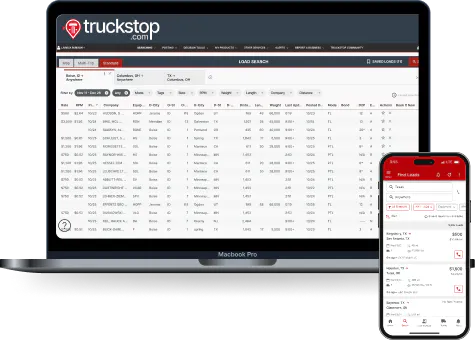
Receipts, invoices, and mileage pile up fast when they live in different places. Transportation management software (TMS) keeps your loads, drivers, equipment, documents, and invoices in one place, so your numbers are organized before you sit down to close the month.
The work usually starts after the load is booked. With Truckstop TMS, a load you save from the Load Board lands in TMS, so you skip the retyping.
Once the load delivers, create the invoice right from it. If you factor, you can submit that invoice to Truckstop Factoring without leaving TMS, subject to approval and terms.
TMS Free is included with your Load Board subscription,^ up to 10 active loads at a time. TMS Basic has no active-load limit and adds three things:
- IFTA estimates. Quarterly IFTA is a chore. TMS Basic helps you calculate mileage and fuel estimates from your TMS data and what you enter. Mileage is estimated from your load data, so keep your own records too. You review the numbers and you file the return.
- A QuickBooks Online integration. Customers and invoices go from TMS to QuickBooks, so you are not entering them twice. Payments do not sync, so mark invoices Paid in TMS. You will need your own QuickBooks subscription.
- Your logo on invoices, so every invoice looks like it came from your business.
TMS works best on a desktop or laptop, so save the bookkeeping for when you pull over or get home.
Run more of your business in one place
Good bookkeeping comes down to a few habits you repeat. Save every receipt, keep your business and personal money apart, and close out each month before the next one starts. Do those three things and tax time stops being a scramble.
Start this week. Pick one system, paper or digital, and file each receipt the day you get it. Then put your loads and invoices in one place so the rest of the routine takes less of your week. Truckstop TMS can be that place, and TMS Free is included with your Load Board subscription.^
^ Factoring is provided through Truckstop Factoring and is subject to underwriting approval and the terms of the factoring agreement. Factoring is not free; a per-invoice fee applies. Applies only to current, qualifying Truckstop Load Board subscribers, for as long as that subscription remains active and in good standing.




Get helpful content delivered to your inbox.
Run more of your business in one place
Loads, broker checks, factoring, and fuel without switching apps ten times a day.





.png)

.png)

