

Owner-operator Q2 2026 outlook: Freight volumes and rates rose, but carrier optimism cooled

Book against
Current rate data
Live loads, broker payment history, and rate guidance in one place on the Truckstop Load Board.
Spot rates are ticking up. A load that paid $2.10 a mile over the winter is closer to $2.30 now, and the phone rings a little more often. The question for a lot of owner-operators is whether to book what is in front of them or hold out for something better paying tomorrow.
Every week spent guessing costs money. Fuel, insurance, and the truck payment do not wait for a better market.
The Q2 Truckstop & Bloomberg Intelligence Carrier Survey asked 644 carriers, most of them owner-operators running one truck, how the second quarter of 2026 went and where they see it going. The survey shows how your numbers stack up against other carriers, and where they expect the freight market to head through late 2026.
Demand is rising, but the recovery is not everywhere yet
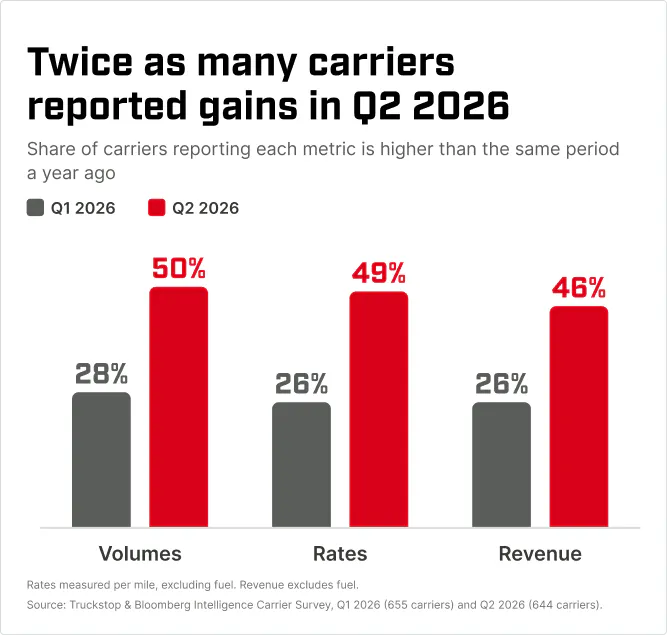
Freight demand is clearly stronger than a year ago. In the survey, roughly half of carriers, 50%, said their load volumes in 2Q26 were up compared to the same period last year. Only 28% said the same in the first quarter, a 22-point jump in one quarter.
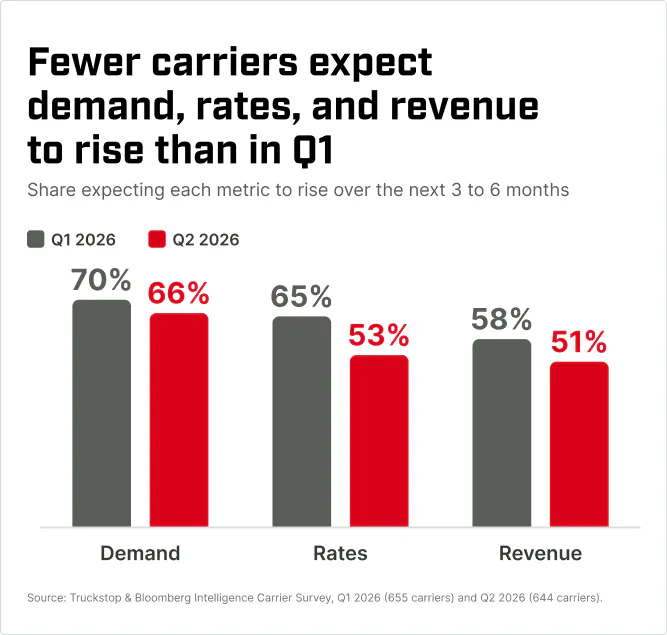
Looking ahead, 66% of carriers expect demand to be higher over the next three to six months. The number is still strong, but it eased from about 70% in the first quarter. Carriers feel the recovery, and a few are less sure how far it runs.
The gains are broad without being universal. Alongside the 50% reporting higher volumes, about 36% saw loads flat against a year ago and 14% saw them down. A rising market still leaves room for a slow stretch, so a soft week does not mean the recovery passed you by.
The quarter-to-quarter read looks steadier than the year-over-year jump suggests. Asked whether demand felt softer than the first quarter, carriers split almost evenly, with a slight majority saying it did not. Freight is holding the ground it gained, even if it is not climbing every week. Check the trend against your own lanes before you turn down a load.
Rates are up, and the outlook is cautiously positive
Rates rose along with volume. Nearly half of carriers, 49%, said their revenue-per-mile excluding fuel was up year over year in 2Q26. In the first quarter, only 26% could say that. A 23-point swing in three months is a real change in the market.
The outlook is positive but more measured. About 53% of carriers expect rates to keep rising over the next three to six months, down from 65% in the first quarter. Another 33% now expect rates to hold flat. More carriers are betting on steady rather than climbing.
The move toward flat expectations explains the hesitation behind the wheel. When most carriers expected rates to keep climbing, holding out for a better load made sense. With a third now expecting flat, booking a fair load today often beats gambling on next week. Knowing where a posted rate sits against the market is what turns that call from a guess into a decision. Rate Insights pulls from paid invoice data, not only posted rates, so the number reflects what brokers have paid recently on the lane.
Fuel and insurance are still the biggest pain points
A better market does not erase the cost side. Asked to rank their biggest challenges, carriers put fuel prices first and insurance costs second, ahead of broker issues, truck parking, and detention.
Fuel is not giving carriers a break. The national average for on-highway diesel climbed to about $5.35 a gallon in early August, up more than $1.50 from a year ago, according to EIA data. Prices keep rising because the Strait of Hormuz still is not fully open, even after the United States and Iran signed a June memorandum to reopen tanker traffic. A deal to reopen the strait is reportedly close, which could ease crude and eventually diesel, but nothing is settled yet.
The price at the pump is one cost you can act on. A fuel card trims cost per gallon on every fill-up, and the Truckstop Fuel Card is worth weighing against the best fuel cards for owner-operators for your lanes.
Insurance is the harder problem. Truck insurance premiums rarely fall once they rise, and a single claim or violation can reset the math for years. There is no quick fix in the survey data. The realistic move is to protect the miles already on the calendar: fewer empty miles, cleaner inspections, and steady lanes that keep the truck earning while the fixed costs stay put.
A stronger market does not fix slow cash
Rising rates help only if the money actually arrives. The survey asked carriers about cash flow for the first time this quarter, and the results show how thin the margin for error runs:
- Nearly 8 in 10 carriers, 79%, already use a factoring service to get paid faster.
- Close to half, 44%, could not keep operating beyond 30 days if payments stopped.
- 77% typically get paid in under a week, which is largely what factoring buys them.
Read together, those numbers point to one issue. Most carriers cannot wait 30 to 45 days for a broker to pay, so they factor to cover fuel and insurance between settlements.
What squeezes them is the stretch between delivery and deposit, and factoring is how they close it. Carrier Factoring from Truckstop Financial is built for that gap, with payment within 24 hours of invoice approval, express funding on nights and weekends, and the choice to factor only the loads you want. Getting paid in hours instead of weeks is what keeps a thin margin from slipping into the red.
Capacity is leaving, which favors carriers who stay in
Capacity is the quiet story under the rates. Fewer trucks chasing the same freight is what pushes rates up, and the survey shows that shift underway. About 32% of carriers expect capacity to tighten over the next three to six months, roughly flat with 34% in the first quarter.
Two forces are thinning the ranks. Equipment costs and weak demand were the top reasons carriers gave in the first quarter for not adding or replacing tractors. A truck that does not get replaced is capacity that quietly leaves the market. Every operator who parks a rig or exits leaves more freight for the ones who stay.
Confidence is holding up better than the soft years would suggest. In 2Q26, 73% of carriers reported being at least somewhat satisfied with the job, up from 61% the quarter before. Carriers who make it through the thin stretch tend to come out with stronger lanes and steadier broker relationships on the other side.
Putting the 2Q26 numbers to work
The 2Q26 survey points to a real recovery. Volumes and rates are up year over year, capacity is tightening, and job satisfaction climbed well above last quarter. Carriers pulled back slightly on how much better it gets from here, which is a reason to book solid freight now rather than wait for a peak that may stay flat.
With rates leveling off and diesel still high, the edge goes to carriers who book against current rate data rather than a hunch. The Truckstop Load Board puts live loads, broker payment history, and rate guidance in one place, so the booking decision and the reload plan happen together instead of across three apps.




Get helpful content delivered to your inbox.
Sign up today.
Find high-quality loads fast, get higher rates on every haul, and access tools that make your job easier at every turn.






.png)

.png)

