

How to Use Data Analytics to Improve Trucking Businesses

Today’s trucking businesses face tighter margins, rising costs, and higher customer expectations than ever before. More businesses are turning to data-driven strategies to stay competitive and boost operational efficiency. From telematics to tablets, technology and data are changing how carriers monitor their assets, manage risk, keep records, make decisions, and ensure compliance.
Both leading carriers and small fleets are adopting analytics to stay competitive, making it an industry standard with benefits you cannot afford to miss out on. In our article, we’ll talk about the ways you can use data analytics to improve your business and stay ahead of the competition.
The role of analytics in trucking
Data analytics help trucking companies save money, stay efficient, and stay safe. By analyzing data from various sources, like telematics, engine sensors, and GPS, trucking companies can:
• Optimize routes: Data analytics helps trucking companies find the best routes by notifying drivers about traffic, road conditions, and delivery windows. These tools help companies reduce their travel time and fuel use.
• Improve fuel efficiency: By looking at driver behavior and engine performance, data analytics tools can help trucking companies reduce fuel consumption and save money.
• Increase operational efficiency: Data-driven tools can determine the best routes, help manage inventory, and speed up processes, increasing overall efficiency.
• Enhance driver performance: Data analytics can track driver behavior, like harsh braking or speeding, to improve training, safety, and efficiency.
• Predict maintenance needs: Modern trucking companies use historical data and algorithms to determine when vehicle parts might fail. They can schedule routine maintenance or fix problems early, preventing costly breakdowns.
What data should trucking companies track?
Trucking companies should track vehicle performance, driver behavior, delivery metrics, finances, and safety and compliance data. This will help them make better decisions to improve efficiency, costs, and safety.
Key data sources in modern trucking operations
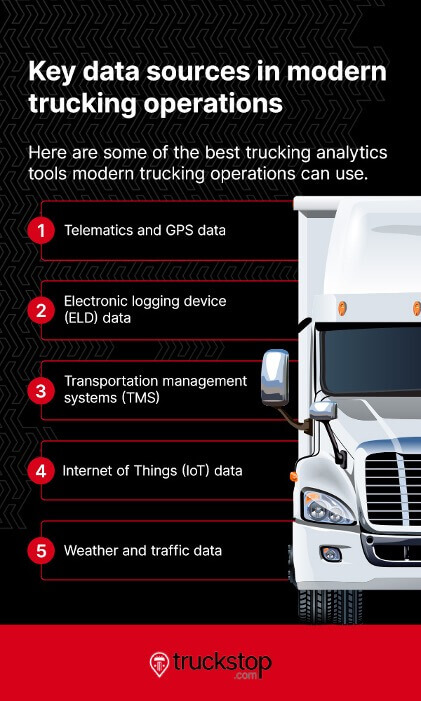
Here are some of the best trucking analytics tools modern trucking operations can use.
1. Telematics and GPS data
GPS tracks your trucks’ locations in real time. It helps drivers plan the best routes, track delivery progress, and manage arrival times with ease. Telematics can also track driver performance metrics like speed, harsh braking, quick acceleration, idling, and seat belt use. With these tools, you can make operations flow much more smoothly and improve safety.
Telematics will also measure engine hours, fuel consumption, diagnostic codes, and other vehicle performance data. This allows you to monitor your vehicle’s health and schedule maintenance at the right time.
2. Electronic logging device (ELD) data
ELDs help you track:
• Hours of service (HOS): ELDs automatically record a driver’s hours on the road and duty status. The tool can help you comply with federal HOS regulations and avoid costly penalties.
• Vehicle movement and engine data: ELDs also capture information about an engine’s on-off status, miles driven, and engine operation duration.
• Driver vehicle inspection reports (DVIRs): ELDs will track the data needed to compile your DVIRs, leading to smoother inspections and maintenance scheduling.
3. Transportation management systems (TMS)
A TMS takes care of many operational processes in trucking. For example, these tools help you manage freight bookings, load assignments, and delivery schedules. They can also plan out routes by considering traffic, road conditions, and tolls, so you can reduce your miles and fuel consumption.
Your TMS also helps with freight auditing and payment processes, and it can be used to track transportation costs and generate invoices.
4. Internet of Things (IoT) data
IoT data uses sensors to track environmental conditions, help secure cargo, and perform maintenance and diagnostics. These devices can track temperature, humidity, and air quality to help protect sensitive cargo. They can also detect theft, damage, or spoilage. Onboard sensors will gather insights about your vehicle’s health and maintenance needs, helping you keep it in good condition over time.
5. Weather and traffic data
Trucking businesses often rely on data from weather and traffic sources. This type of data helps truckers avoid traffic congestion and road closures and plan out routes better. Weather data also influences driving speed and safety considerations. Having information about road and weather conditions can help avoid delays and make deliveries faster.
Essential analytics metrics for trucking success
Trucking companies should pay close attention to certain key performance indicators (KPIs) and metrics. Look at your financial, operational, safety, and driver performance metrics to stay profitable and competitive.
Here are some trucking data analytics examples.
1. Cost per mile
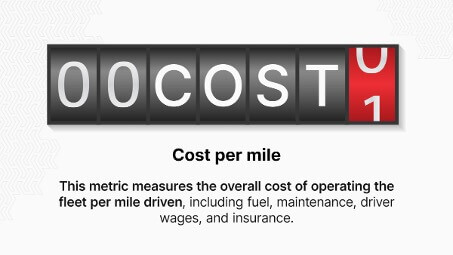
One of the most necessary analytics for small trucking companies and large operations alike is the cost per mile. This metric measures the overall cost of operating the fleet per mile driven, including fuel, maintenance, driver wages, and insurance. You can calculate your cost per mile by dividing the total operational costs by the total miles driven. Keeping your cost per mile low is important in maximizing profits.
2. On-time delivery (OTD) rate
The on-time delivery rate tracks the percentage of shipments delivered within the agreed time frame. You can calculate this metric by dividing the number of on-time deliveries by the total number of deliveries, and then multiplying that number by 100. For example, if you deliver 35 out of 50 deliveries on time, your OTD rate is 70%. A high rate can show that you are more efficient and will directly contribute to customer satisfaction and loyalty.
An OTD rate of 95% and above is generally considered excellent, meaning your company delivers goods on or before the promised delivery rate at least 95 times out of 100.
3. Fuel efficiency
Fuel efficiency measures the miles traveled per gallon of fuel consumed. Metrics in this category can be influenced by driving habits, vehicle maintenance, and load weight. Improving your fuel efficiency can help reduce operational costs.
4. Fleet utilization rate
Fleet utilization is the percentage of time vehicles in the fleet are in use. A higher utilization rate leads to improved asset management and revenue generation. You’ll want to aim for a higher percentage, but be sure to tailor the number to your specific industry, fleet type, and operation.
5. Driver turnover rate
Driver turnover rate tracks how often drivers leave your company. You can calculate this metric by dividing the number of drivers who left by the average number of drivers and multiplying by 100. For example, if 12 out of 60 drivers leave your company in a year, your driver turnover rate for that year is 20%. A high turnover rate can mean there are issues with driver satisfaction or working conditions. Reducing turnover can help you keep operations efficient and manage recruiting costs.
6. Maintenance cost per mile
Maintenance cost per mile includes the average cost of maintaining your vehicles per mile driven. The metric is critical when budgeting and managing your costs. It affects how long the vehicle lasts and can predict and prevent downtime. A report from Fleet Equipment Magazine found that fleets spend an average of 15 cents per mile on maintenance.
7. Revenue per mile
Revenue per mile tracks the total revenue you generate for each mile driven. It’s often best for assessing your pricing strategies and the profitability of different routes.
Practical benefits and applications of analytics in trucking
New technologies are making it easier than ever to reap the benefits of data in trucking. Here’s how data improves trucking, from the supply chain to safety, shipping, and compliance.
Optimizing the supply chain
Most of your data is produced in your supply chain. With so many moving parts, technology can help sort the data created and help you improve your supply chain. More specifically, tracking predictive analytics lets you project supply and demand for the future. This way, you can stock your products appropriately and reduce waste or excess inventory.
Improving shipping
Data analytics is also critical in improving your shipping processes and delivery times. This technology can help you predict shipping times more accurately and also show the best routes or transportation methods to improve your delivery times and reduce delays. You can even use the data to predict delays and let customers know upfront, or even avoid the issue altogether.
Reducing costs
Data analytics will show you the money you are spending and where it’s going. With these numbers laid out, you can spot areas to reduce costs or invest more. Data analytics tools can also help you save on fuel costs by planning out shorter routes where you spend less time idling or dealing with traffic congestion.
Increasing efficiency
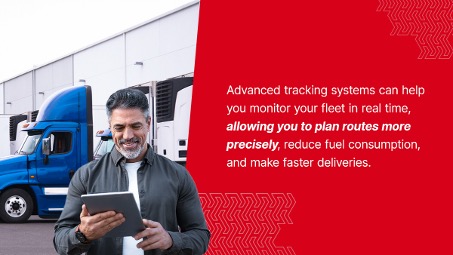
Advanced tracking systems can help you monitor your fleet in real time, allowing you to plan routes more precisely, reduce fuel consumption, and make faster deliveries. They can also help you with compliance and reduce administrative costs, as tools will automatically audit and store crucial data for you. Employees can always access what they need.
Enhancing safety and compliance
ELDs, dashcams, electronic control modules (ECMs), and other advanced systems can improve compliance and safety. They can spot potentially dangerous driving behaviors and out-of-service violations. Certain systems can also help improve an employee’s driving skills and catch licensing issues before they lead to costly penalties. Analytics can help you stay ahead of changing regulations.
Additionally, predictive maintenance tools use vehicle data to spot potential mechanical issues, so you can address them before they lead to breakdowns.
Gaining a competitive advantage
Data analytics lays out a full view of everything going on in your business. You can get an unbiased view of numbers and statistics, as well as areas to improve. For example, you can determine areas where numbers aren’t where they should be and make updates, like choosing a more profitable mode of transportation to cut costs.
Essentially, data analytics lets you take a step back, see exactly what might be eating into your profit margin, and reorganize to account for gaps. Improve trucking profits with data and stay ahead of the competition.
Implementing analytics in your trucking business
Here’s how to use data in your trucking business for your success.
1. Identify your goals
You’ll need to build your foundation before you start seeing trucking improvements from your data. Where do you want to improve? Whether it’s fuel costs, on-time delivery, or driver retention, identify any gaps. Then, you can choose the right tools.
2. Choose the right tools
To implement analytics in your business, you’ll need to invest in technology. Partnering with reliable and experienced technology providers can help you integrate data analytics much more smoothly. Choose a user-friendly, scalable platform that can integrate with your existing system to save you time.
3. Ensure data quality
Establish clear processes for gathering your data. This includes having a standardized system for data entry and cleaning up old records. This will ensure that your data is accurate and can be analyzed effectively.
4. Train your team
Continuous learning and adaptation are important to realize the full benefits of data analytics. Make sure your employees understand how valuable the data you collect really is and how to use the analytics tools correctly.
5. Start small and scale up
Start with just a few key metrics you want to track, and expand as your team gets comfortable. This will make it easier to use the technology and benefit from it without it feeling too overwhelming. Working with an expert team can also make the process of implementing new technology much smoother and easier for your company.
6. Review and adjust
To make the most of your data, make sure you’re continually analyzing results, getting feedback, and refining your approach. Over time, you’ll be able to realize the full benefits of this technology and find new opportunities for success.
Take the next steps to power your data strategy with Truckstop
Trucking companies that want to stay ahead in a competitive industry should look for the best ways to cut costs, simplify compliance, and improve their efficiency. Data analytics tools are helping businesses achieve exactly this. Truckstop’s tools are easy to use, trusted in the industry, and designed for real trucking businesses, not just big fleets.
Our analytics solutions, including our trucking TMS, can cut time-consuming tasks from your workload and help you manage your operations with greater ease. Gain a competitive edge with advanced features like load management, IFTA reporting, payroll processing, and more. With reporting and analytics features, our solutions will help you create reports with accurate performance metrics.
Request a demo today to see how our analytics solutions can take your business to the next level.




Get helpful content delivered to your inbox.
Sign up today.
Find high-quality loads fast, get higher rates on every haul, and access tools that make your job easier at every turn.






.png)

.png)

