

Q1 2026 Freight Fraud Trends Report

Gain a deeper
Understanding of the spot market.
Price every load right and make more money. Truckstop's Spot Market Insights is a must-have resource.
Freight fraud didn’t let up in Q1 2026.
Truckstop’s risk and trust teams audited 15,315 accounts last quarter, up 13 percent from the prior quarter. More scrutiny is showing up in the results. Blocked access to the load board increased quarter over quarter, meaning more bad actors are being stopped before they ever reach a load.
Here’s what the data showed, and what it means for carriers and brokers moving freight right now.
What the numbers show quarter over quarter
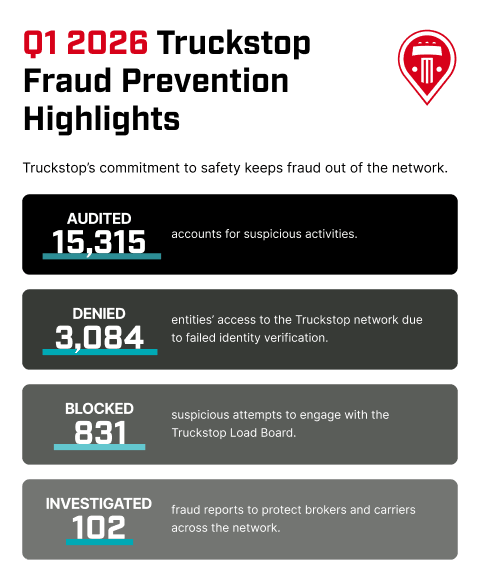
The increase in audited accounts tells part of the story. The other part is what happened at the verification stage.
Identity verification failures actually dropped quarter over quarter, even as more accounts were reviewed. That’s the screening process catching problems earlier in the cycle.
When it came to blocked access, the largest share were unqualified accounts, making up more than half of all blocks. About 1 in 5 were accounts that simply couldn’t be verified.
Inactive authority and cases where the registered owner didn’t approve the application made up most of the remainder, with a smaller share flagged during security review for invalid addresses or active complaints.
Reported fraud cases investigated by Truckstop’s teams dropped by more than half compared to Q4 2025, including cases of double brokering and identity-based schemes.
When more bad actors are caught and blocked at the verification stage, fewer problems get far enough to become a formal fraud case. The goal of prevention is to stop fraud before it happens, and the data reflects that shift.
Fake IDs are leading identity fraud attempts
Of the 3,084 identity verification failures in Q1 2026, government ID issues were the single largest cause, accounting for more than half of all failures. Face verification and liveness check failures each made up roughly 1 in 6 failures, with phone verification accounting for most of the rest.
That breakdown matters. When multiple parts of an identity fail at once, with the ID looking off, the face not matching, and the phone unconfirmable, it’s rarely a coincidence.
Fraudsters are putting together more complete packages now, not just submitting one weak piece of documentation. AI-generated credentials have made fake IDs look more polished than they used to, which puts more pressure on layered verification rather than a quick visual scan.
For carriers, that means someone could be impersonating your MC number right now and you might not know until a load goes missing or a payment dispute surfaces.
Steps you can take right now
The Q1 data points to several clear places where fraud gets in. Whether you’re a broker vetting a new carrier or a carrier evaluating a load opportunity, these steps apply before anything moves:
- Verify independently every time. Brokers should confirm DOT and MC numbers, authority status, and insurance directly through FMCSA, not through documentation the carrier provides. Carriers should verify broker licenses through the FMCSA broker search before accepting a load.
- Check authority status, not just DOT numbers. An authority can exist in the system without being active. Confirm operating status before committing to a load.
- Call the right number. Use the phone number listed on FMCSA or the company’s official website, not the number provided during introduction. This applies to both sides of the transaction.
- Verify insurance directly. Brokers should request the Certificate of Insurance and confirm it with the provider, not just with the carrier. Carriers should also monitor their own insurance and authority records for signs of unauthorized changes.
- Lock down your own credentials. Use strong passwords and two-factor authentication for load board access, fuel card accounts, payment portals, and business email. Stolen credentials create losses that take far longer to recover from than the load itself.
- Be deliberate about payment timing. Brokers should restrict early payment options to carriers with a verified track record. Carriers should be cautious of brokers offering unusually fast or off-platform payment arrangements.
- Treat urgency as a signal. Pressure to skip steps or move fast is one of the most consistent indicators that something is wrong. If a situation feels rushed, know how to report it.
RMIS Carrier Onboarding layers these checks together so brokers don’t have to run them one by one, and so nothing gets skipped under time pressure.
Keeping the load board safe is a shared effort
Freight fraud is a shared problem, and holding it back requires consistent effort from every side of the transaction. Every verified carrier, confirmed contact, and properly closed deal helps protect the network that brokers and carriers depend on.
Truckstop’s teams monitor for risk continuously, investigate reported cases, and work to make sure the companies on the load board are who they say they are. The Q1 data reflects that work, and points to where vigilance needs to stay high as 2026 continues.
“There is no silver bullet for fighting fraud. We all must stop fighting each other and start fighting the problem, together,” said Dale Prax, freight fraud consultant for Truckstop.com.
You can read the full 2025 Freight Fraud Report for a year-over-year view of how these patterns developed.
Protect your business, your reputation, and your freight network.
Topics:




Get helpful content delivered to your inbox.
Sign up today.
Find high-quality loads fast, get higher rates on every haul, and access tools that make your job easier at every turn.






.png)

.png)

