

Carrier insurance requirements by state: A complete breakdown
What are you waiting for?
Make more money starting now.
Navigating insurance regulations can be overwhelming for freight carriers and owner-operators. While federal regulations offer a baseline for interstate commerce, every state has its own set of rules to follow.
Read on to explore the different liability limits, filing types, and cargo stipulations across the country. We’ll go state by state, breaking down the different insurance requirements. That way, you can make sure your fleet is compliant wherever the road takes you.
What are the federal carrier insurance minimums?
The federal minimum for public liability insurance is $750,000 for general freight carriers with vehicles over 10,000 pounds. This general coverage combines bodily injury (BI) and property damage (PD) into a single limit. The Federal Motor Carrier Safety Administration (FMCSA) has set this financial requirement. These insurance requirements work alongside your USDOT and MC number filings to establish financial responsibility. It applies to all carriers transporting passengers or property across state lines. However, the requirements increase for specialized freight:
- Oil and hazardous materials: Carriers transporting oil or hazardous waste generally require $1 million in liability coverage.
- Explosives and gas: For portable tanks, hopper-type vehicles with capacities over 3,500 water gallons, or Class A or B explosives, the minimum jumps to $5 million.
The FMCSA also requires an MCS-90 endorsement for your policy. It proves to the public that your insurer will pay a claim even if the specific accident isn’t in the policy terms. This is subject to reimbursement by you. It’s proof of financial responsibility that you must attach to your policy.
Motor carrier liability insurance limits by state
The following list breaks down the commercial carrier insurance requirements by state. While interstate carriers need to follow FMCSA limits, they also need to register with states through the Unified Carrier Registration (UCR). They might also have to file specific forms to prove their coverage, like Form E.
Intrastate carriers, on the other hand, will have to follow specific liability limits. These are set by that state’s department of transportation or public utility commission.
Here are the state-specific insurance requirements for motor carriers, including minimum liability limits, required policy types, and key regulations:
Alabama
The Alabama Public Service Commission (APSC) regulates for-hire carriers. It requires filing a Form E to prove coverage. You also need continuous coverage to maintain your operating authority.
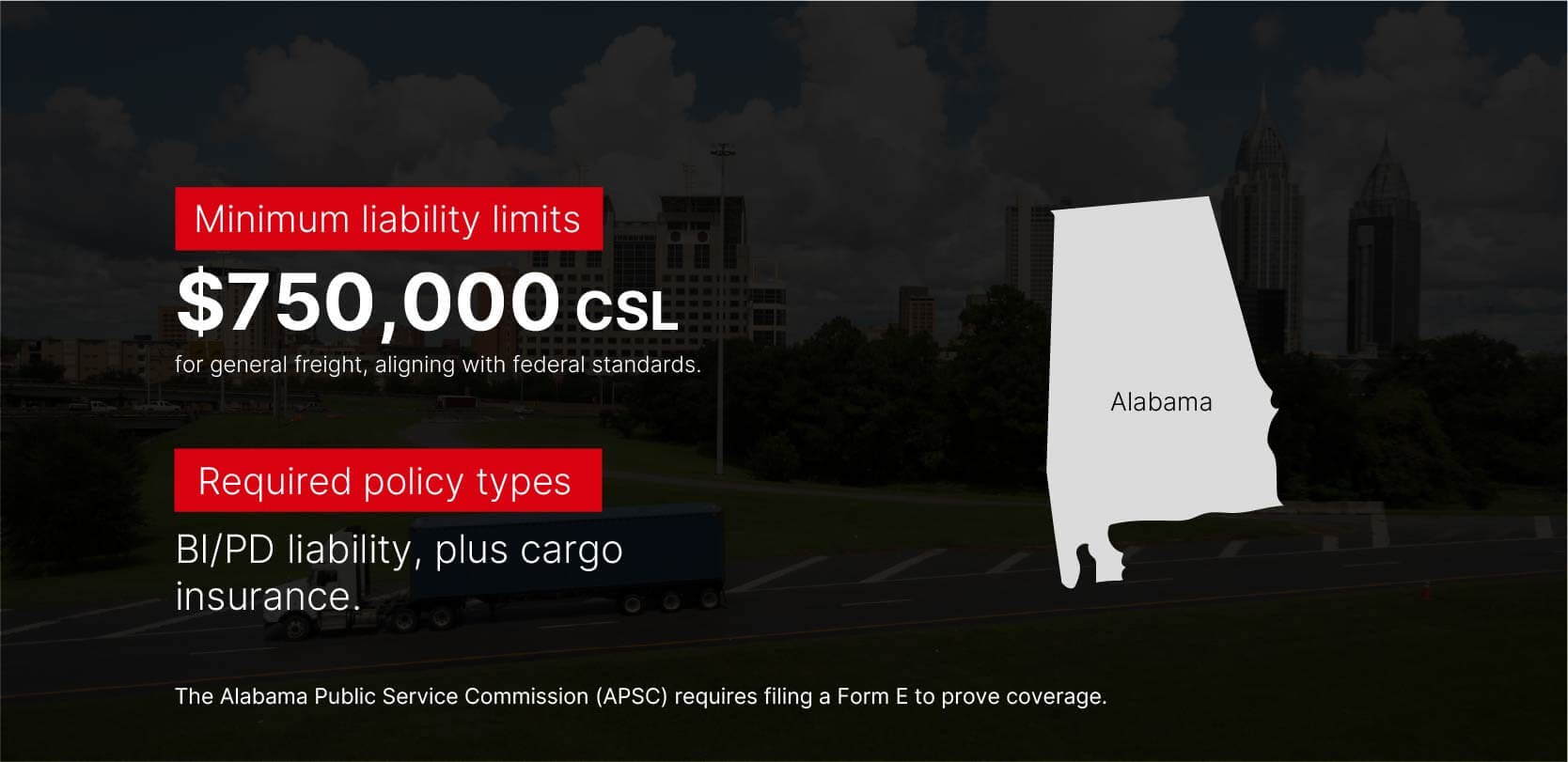
- Minimum liability limits: General freight is $750,000 combined single limit (CSL), aligning with federal standards.
- Required policy types: BI/PD liability, plus cargo insurance.
Alaska
The Alaska Department of Transportation and Public Facilities (DOT&PF) requires proof of insurance for carriers. The state largely adopts federal FMCSA regulations for carriers operating on its highway system.
- Minimum liability limits: $750,000 CSL is the minimum liability limit. This follows the federal standard for general freight trucks over 10,000 pounds.
- Required policy types: BI/PD liability.
Arizona
The Arizona Department of Transportation (DOT) requires all freight carriers to have continuous coverage. Without it, they face registration suspension. Failure to show proof of insurance could lead to penalties.
- Minimum liability limits: The minimum liability limit for Arizona carriers is $750,000 CSL.
- Required policy types: BI/PD liability.
Arkansas
The Arkansas Towing and Recovery Board and state police enforce insurance rules for carriers. Intrastate carriers must have proof of insurance on file with the correct state authority.
- Minimum liability limits: The state has adopted federal minimums. It requires $750,000 CSL for general freight carriers operating vehicles over 10,000 pounds.
- Required policy types: BI/PD liability.
California
All carriers in California must get their California Motor Carrier Permit (MCP) to operate. This is directly tied to their insurance status. The Department of Motor Vehicles (DMV) enforces coverage to maintain an active MCP.
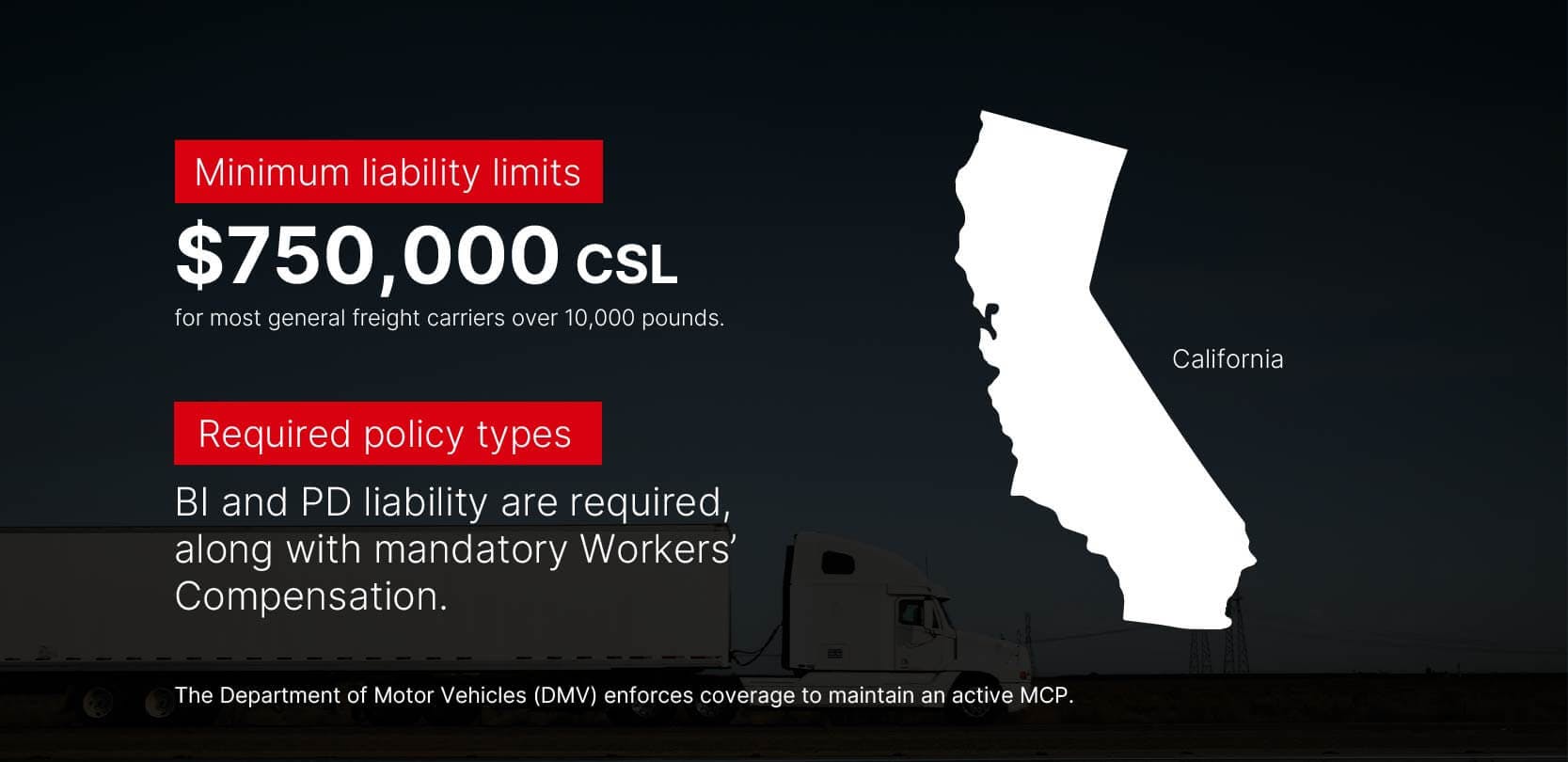
- Minimum liability limits: $750,000 CSL for most general freight carriers with vehicles over 10,000 pounds.
- Required policy types: BI and PD liability are required, along with mandatory Workers’ Compensation.
Colorado
The Colorado Public Utilities Commission (PUC) requires insurance companies to file proof of coverage online directly for motor carriers in this state. An active filing is required to maintain operating authority.
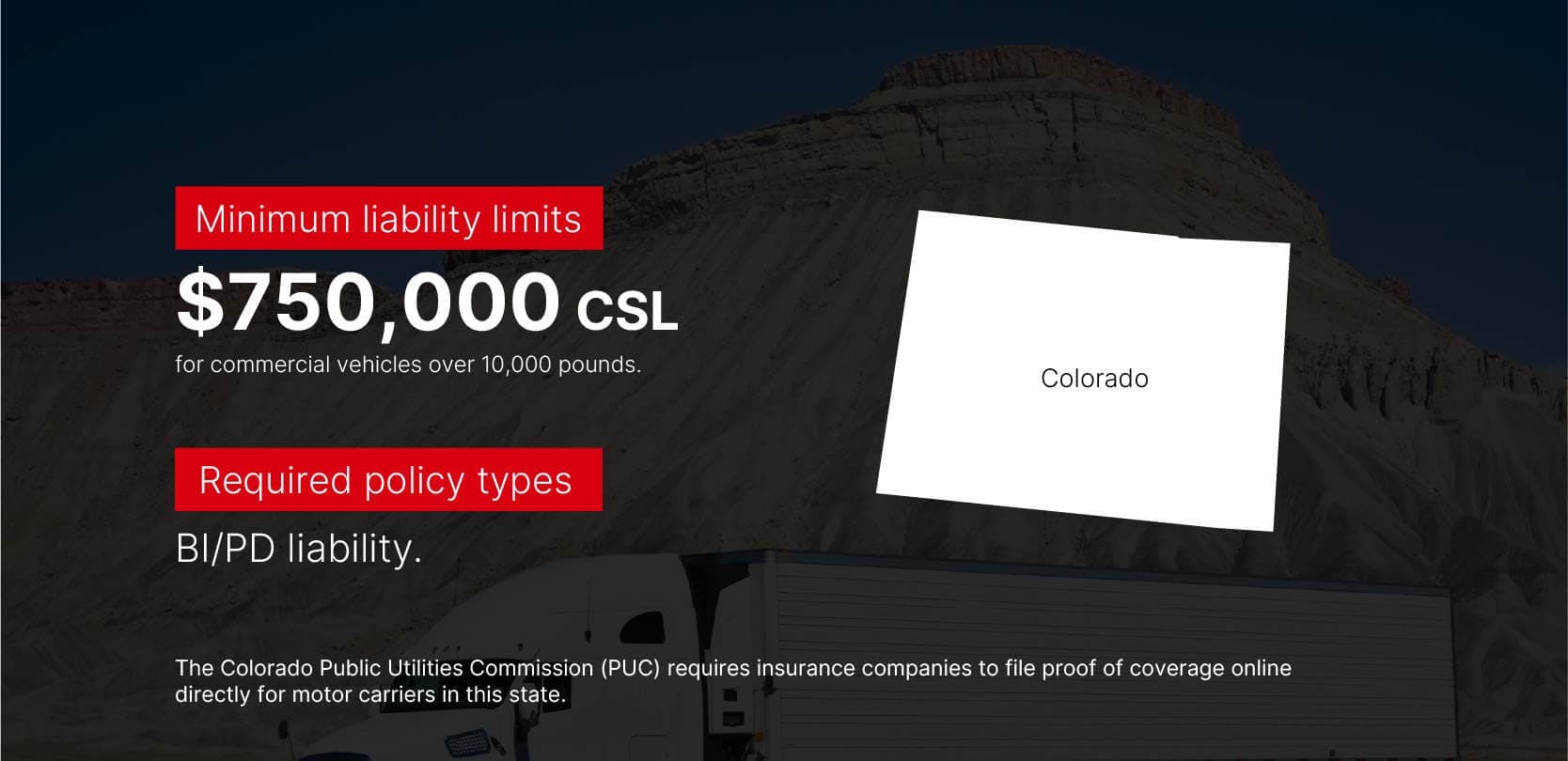
- Minimum liability limits: $750,000 CSL for commercial vehicles over 10,000 pounds.
- Required policy types: BI/PD liability.
Connecticut
In Connecticut, the DMV’s Compliance Unit requires all carriers to have an Acord Certificate of Liability Insurance on file. The state actively monitors for lapses in coverage for all commercial vehicles.
- Minimum liability limits: $750,000 for for-hire property carriers.
- Required policy types: BI/PD liability.
Delaware
State law requires public carriers in Delaware to have liability insurance. The Delaware Department of Transportation (DelDOT) and DMV enforce these rules during vehicle registration and inspection.
- Minimum liability limits: Follows the federal standard of $750,000 CSL for most for-hire property carriers.
- Required policy types: BI/PD liability.
Florida
In Florida, the Florida Highway Safety and Motor Vehicles (FLHSMV) requires all commercial vehicles to maintain continuous coverage. Lapses can lead to immediate registration and license plate suspension until you provide proof and pay fines.
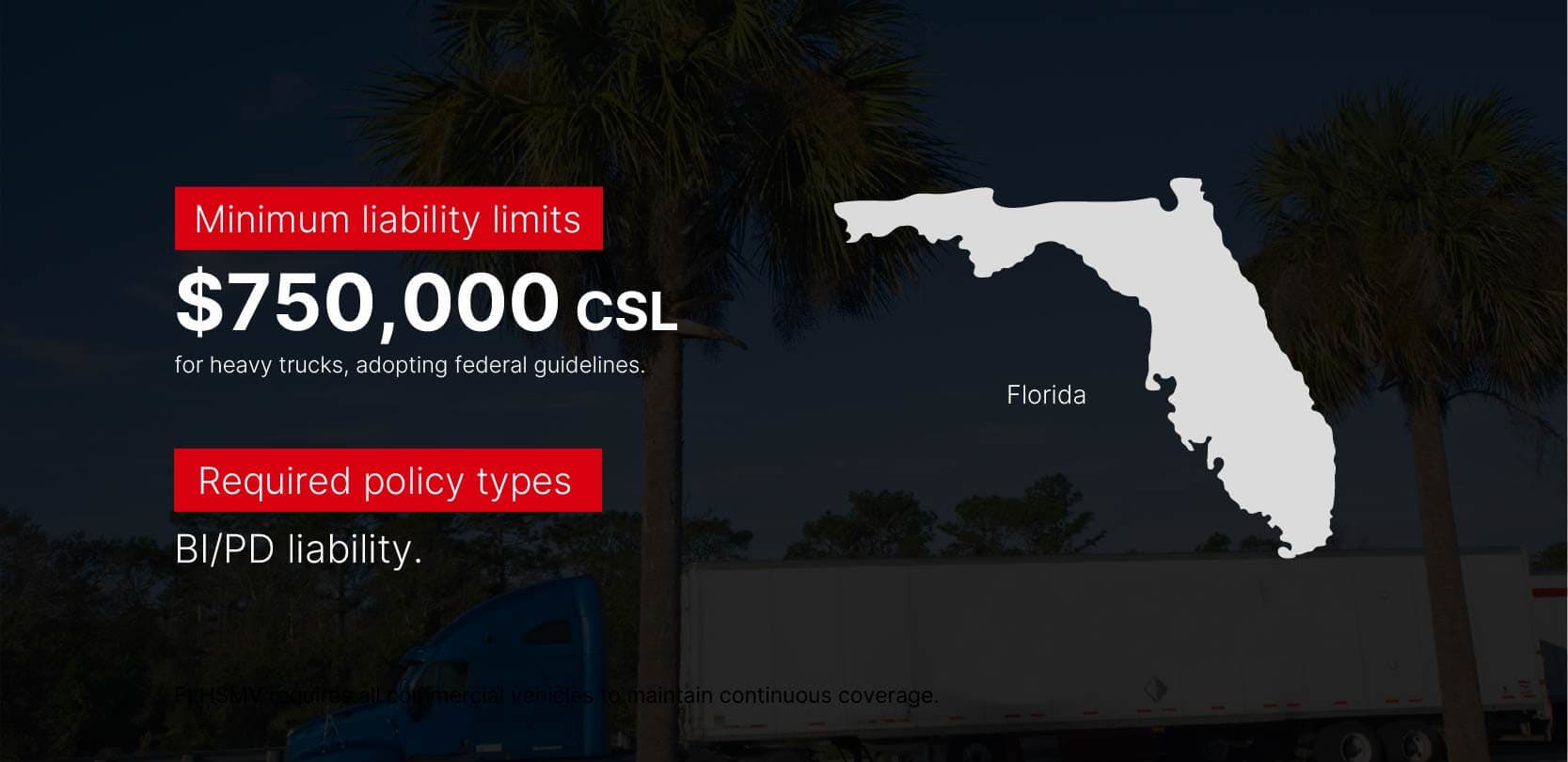
- Minimum liability limits: $750,000 CSL for heavy trucks, adopting federal guidelines.
- Required policy types: BI/PD liability.
Georgia
The Georgia Department of Revenue (DOR) requires carriers registering under the International Registration Plan (IRP) to show proof of insurance. They must maintain a valid policy to keep their registration active.
- Minimum liability limits: Follows federal minimums, typically $750,000 CSL for commercial trucks over 10,000 pounds.
- Required policy types: BI/PD liability.
Hawaii
The Hawaii PUC requires all for-hire motor carriers to obtain a certificate. This shows proof of valid insurance coverage.
- Minimum liability limits: $750,000 for BI/PD per accident for property carriers.
- Required policy types: BI/PD liability.
Idaho
The Idaho Transportation Department requires carriers to file proof of insurance and maintain coverage to keep their vehicle registration.
- Minimum liability limits: $750,000 for property carriers.
- Required policy types: BI/PD liability.
Illinois
The Illinois Commerce Commission (ICC) requires all for-hire carriers to file proof of insurance to get and keep their authority.
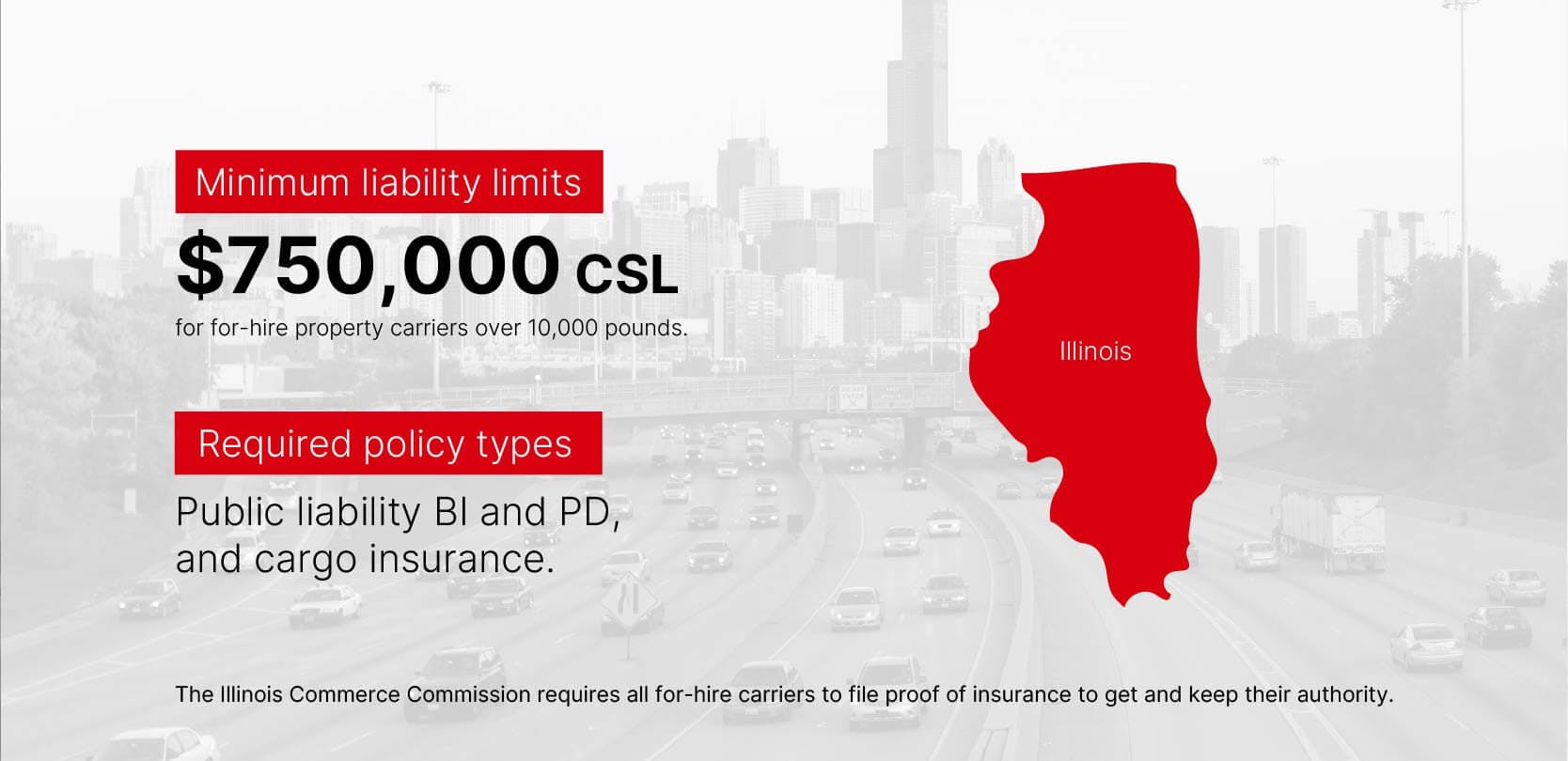
- Minimum liability limits: $750,000 CSL for vehicles over 10,000 pounds.
- Required policy types: Public liability BI and PD, and cargo insurance.
Indiana
The Department of Revenue’s Motor Carrier Services division requires all for-hire carriers to have an active insurance policy on file from an Indiana-licensed insurer.
- Minimum liability limits: Adopts federal guidelines; $750,000 for vehicles over 10,000 pounds.
- Required policy types: BI and PD liability.
Iowa
The Iowa DOT requires for-hire intrastate carriers to file proof of insurance to receive operating authority. The state actively monitors for compliance.
- Minimum liability limits: Aligns with federal standards, requiring $750,000 CSL for most for-hire operations.
- Required policy types: BI and PD liability.
Kansas
The Kansas Corporation Commission (KCC) enforces insurance rules. All for-hire motor carriers must maintain proof of insurance on file with the KCC to operate legally.
- Minimum liability limits: Adopts the federal minimum of $750,000 CSL for general freight over 10,000 pounds.
- Required policy types: Public liability (BI/PD).
Kentucky
The Kentucky Transportation Cabinet (KYTC) requires intrastate for-hire carriers to file a Form E from their insurer before an operating certificate is granted.
- Minimum liability limits: Varies by weight and commodity, but generally aligns with the $750,000 federal minimum for heavy trucks.
- Required policy types: BI/PD liability.
Louisiana
The Louisiana Public Service Commission (LPSC) requires all motor carriers to maintain proof of insurance via its General Orders. Lapses can result in certificate cancellation.
- Minimum liability limits: Follows federal minimums, typically $750,000 CSL.
- Required policy types: BI/PD liability through Form E and often cargo liability through Form H.
Maine
Maine requires carriers to file proof of insurance, and cancellation requires a 30-day notice. Insurers must send a Form K to the Bureau of Insurance and the carrier.
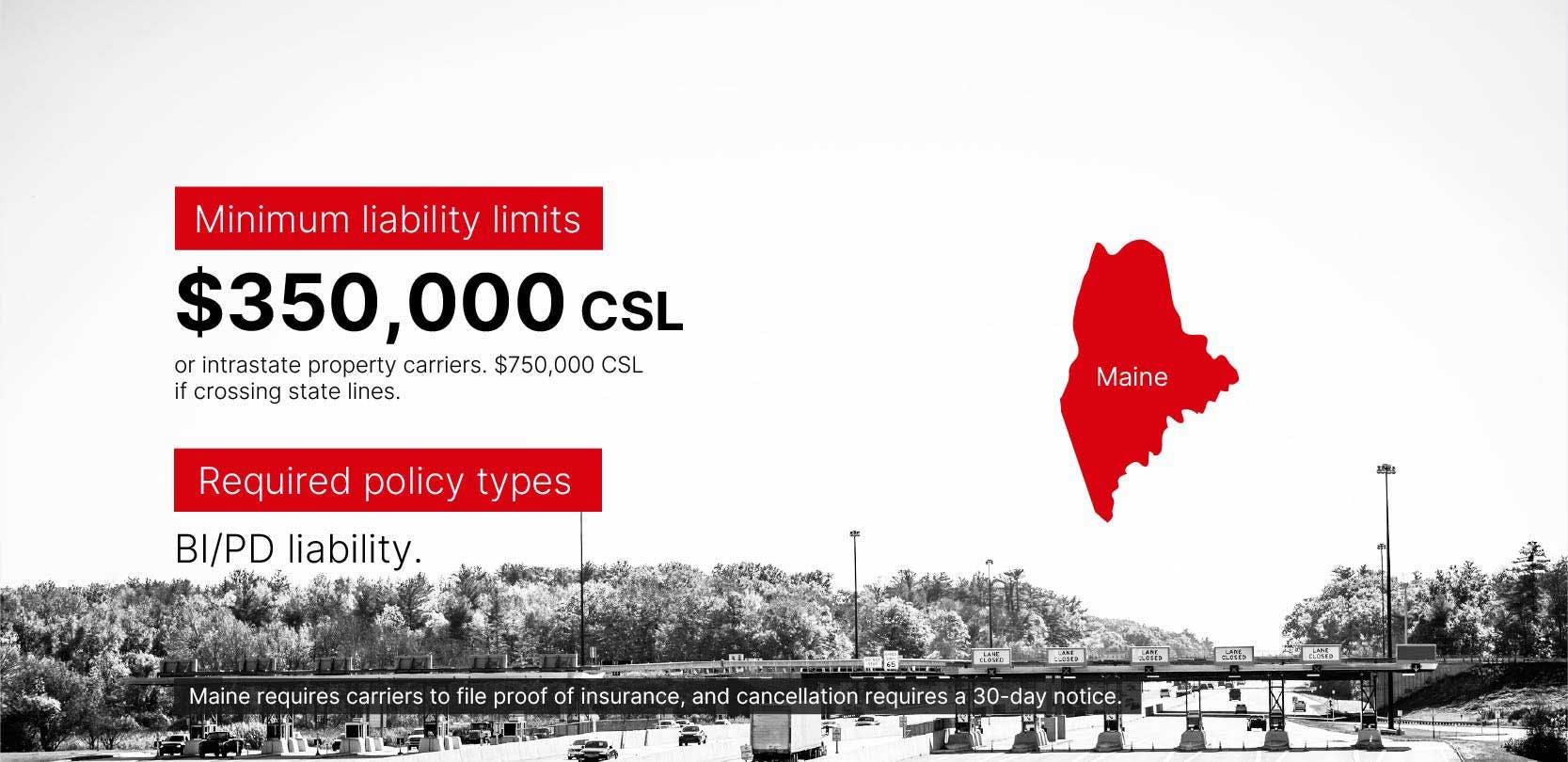
- Minimum liability limits: Maine’s state law requires only a $350,000 CSL for intrastate property carriers. However, you will need the $750,000 CSL if crossing state lines.
- Required policy types: BI/PD liability.
Maryland
Maryland is a mandatory insurance state. The Motor Vehicle Administration (MVA) actively verifies coverage, and lapses can lead to registration suspension and fines.
- Minimum liability limits: For-hire commercial carriers must meet the federal standard of $750,000 CSL.
- Required policy types: BI/PD liability.
Massachusetts
In Massachusetts, the Department of Public Utilities (DPU) Transportation Oversight Division requires all for-hire carriers of property to file proof of insurance to get and keep operating authority.
- Minimum liability limits: Adopts federal minimums, requiring $750,000 CSL for most commercial trucking operations.
- Required policy types: BI/PD liability.
Michigan
Michigan has unique no-fault insurance laws. The Michigan State Police Commercial Vehicle Enforcement Division (CVED) enforces these rules, regulating vehicle safety, qualifications, and carrier operations for-hire.
- Minimum liability limits: $750,000 CSL for most for-hire carriers, aligning with federal standards.
- Required policy types: No-fault personal injury protection (PIP), and BI/PD liability.
Minnesota
The Minnesota DOT requires intrastate carriers to file a Form E to prove coverage. Failure to maintain insurance can lead to suspension of operating authority.
- Minimum liability limits: $750,000 for general commodities.
- Required policy types: BI/PD liability.
Mississippi
The Mississippi DOT requires all intrastate general freight carriers to file a Certificate of Insurance to receive operating authority. This is often done through specific forms like the MCS-90 Endorsement.
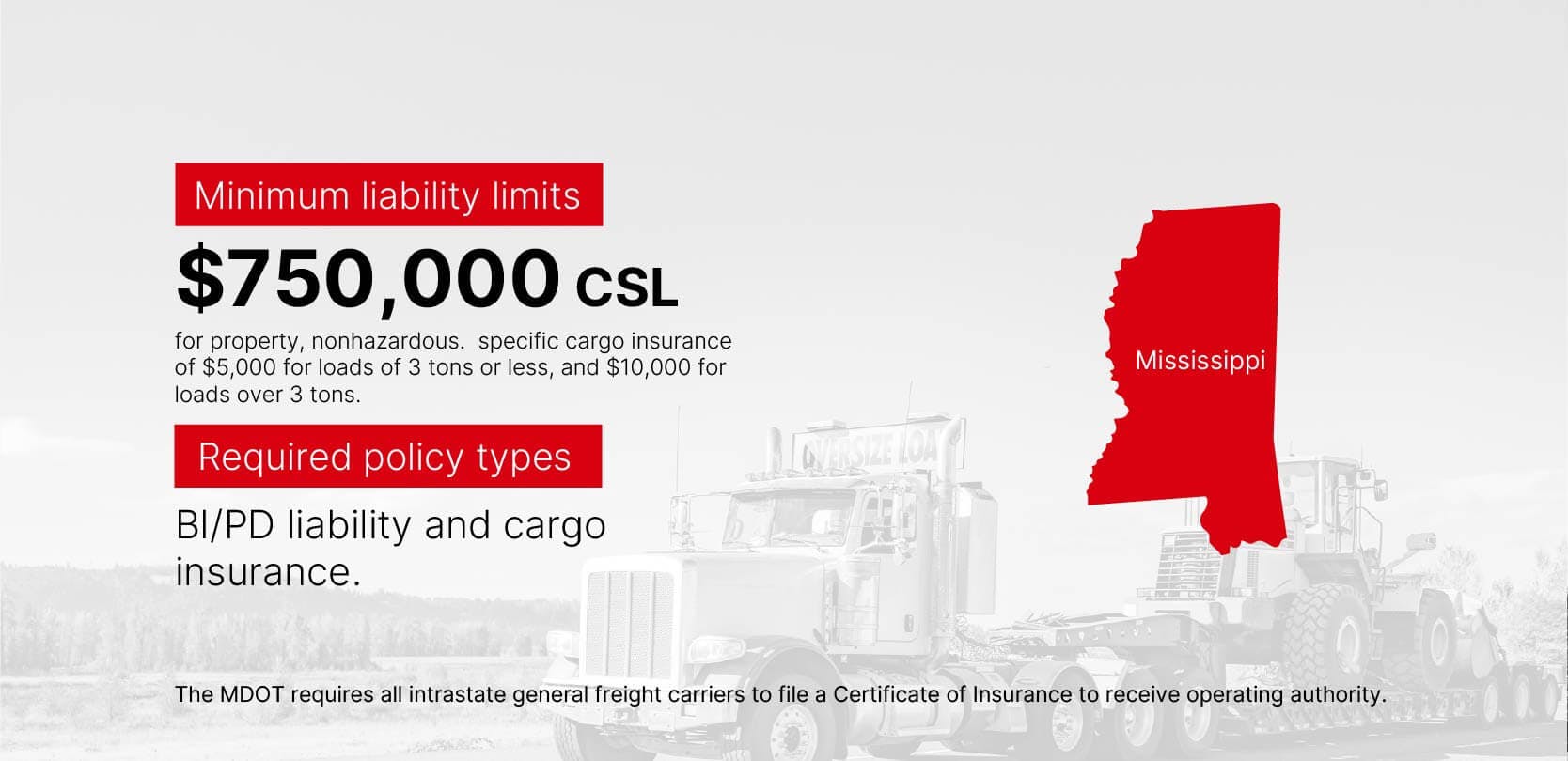
- Minimum liability limits: The minimum liability limit is $750,000 for property, nonhazardous. Mississippi also requires specific cargo insurance of $5,000 for loads of 3 tons or less, and $10,000 for loads over 3 tons.
- Required policy types: BI/PD liability and cargo insurance.
Missouri
The Missouri DOT’s regulations require all motor carriers to maintain continuous insurance coverage. Lapses result in suspension of the carrier’s operating authority.
- Minimum liability limits: $750,000 CSL, reflecting the federal minimum for most commercial operations.
- Required policy types: Public liability (BI/PD).
Montana
The Montana Public Service Commission regulates for-hire carriers. Carriers must file proof of insurance to obtain operating certificates.
- Minimum liability limits: Follows federal guidelines, typically requiring $750,000 CSL for general freight operations.
- Required policy types: Public liability (BI/PD).
Nebraska
The Public Service Commission requires for-hire carriers to have proof of insurance on file. The Nebraska State Patrol enforces these rules during roadside inspections.
- Minimum liability limits: Follows federal minimums, requiring $750,000 CSL for general freight. Nebraska also requires carriers to file proof of cargo insurance (Form H) with a minimum of $5,000.
- Required policy types: BI/PD liability.
Nevada
The Nevada DMV requires intrastate carriers to file proof of insurance, often as Accord, Form E covering BI/PD and Form H covering cargo liability.
- Minimum liability limits: $750,000 for vehicles 26,001 pounds or more.
- Required policy types: BI/PD liability and cargo liability.
New Hampshire
The New Hampshire DMV enforces financial responsibility laws. The administrative rules, Saf-C 7500 and 900, include the specific requirements for motor carriers operating in the state.
- Minimum liability limits: Adopts federal minimums, requiring $750,000 CSL for for-hire property carriers.
- Required policy types: BI/PD liability.
New Jersey
New Jersey’s Administrative Code, specifically Title 13, Chapter 60, incorporates federal motor carrier safety regulations by reference, making them applicable to intrastate commerce. They are enforced by the New Jersey Motor Vehicle Commission (MVC).
- Minimum liability limits: Aligns with federal standards, requiring $750,000 CSL for most for-hire operations.
- Required policy types: BI/PD liability.
New Mexico
The NM Administrative Code Title 18, Chapter 3, requires motor carriers to maintain financial responsibility. Lapses can lead to suspension or revocation of authority.
- Minimum liability limits: Adopts federal requirements, specifying $750,000 for property carriers over 10,000 pounds.
- Required policy types: BI/PD liability.
New York
The New York State Department of Transportation strictly enforces insurance rules. Proof of both liability and workers’ compensation coverage is often required to obtain and maintain an operating permit.
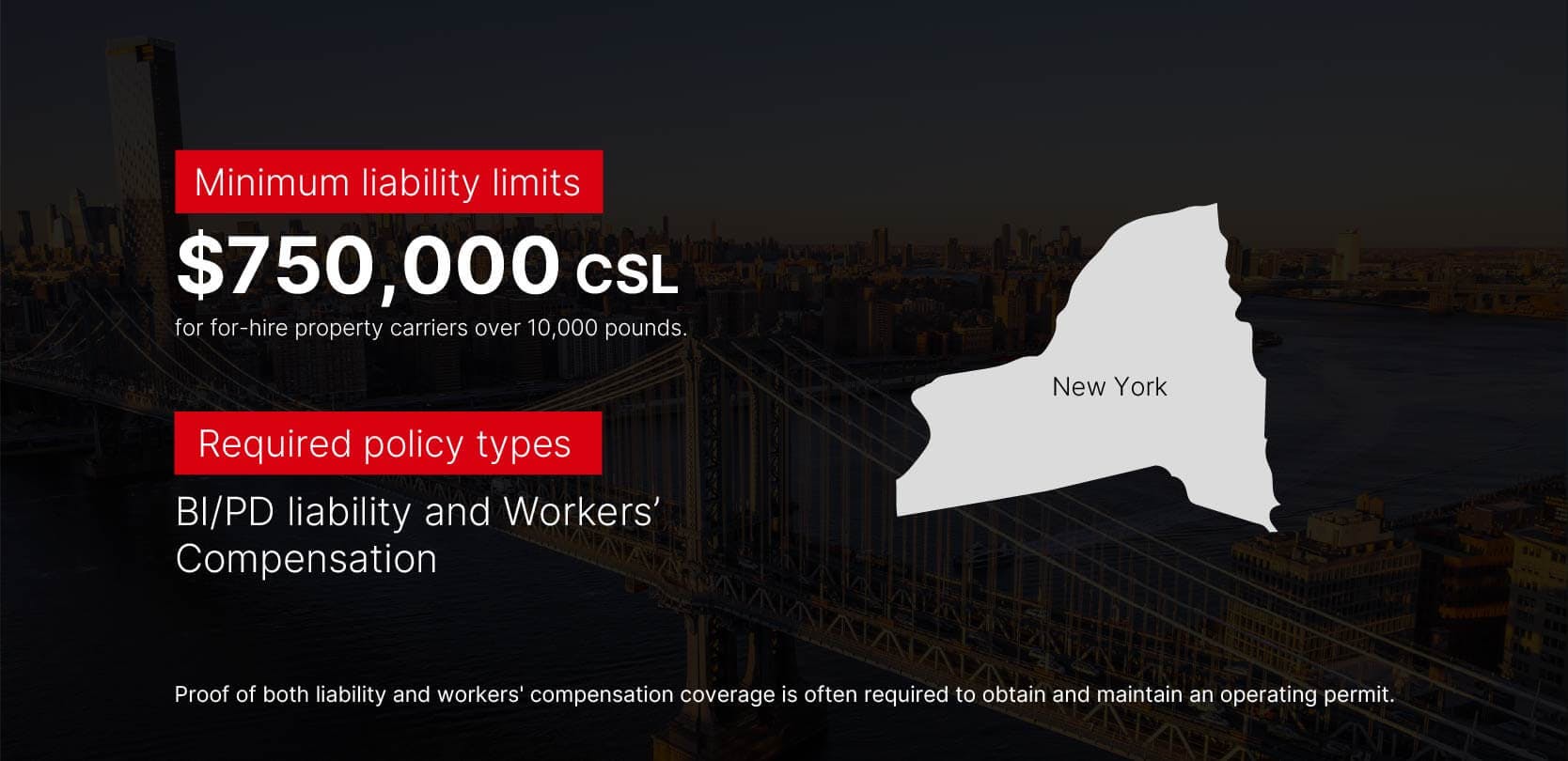
- Minimum liability limits: $750,000 CSL for for-hire property carriers over 10,000 pounds.
- Required policy types: BI/PD liability and Workers’ Compensation.
North Carolina
The North Carolina DMV requires all commercial motor vehicle owners to have financial responsibility on file. The state actively cross-references this information with vehicle registrations.
- Minimum liability limits: $750,000 for for-hire carriers transporting nonhazardous property.
- Required policy types: BI/PD liability.
North Dakota
The North Dakota State Highway Patrol and DOT oversee motor carrier operations. North Dakota largely adopted federal standards for vehicles engaged in commerce.
- Minimum liability limits: $750,000 for commercial trucks over 10,000 pounds, following federal guidelines.
- Required policy types: Motor vehicle liability (BI/PD).
Ohio
The Public Utilities Commission of Ohio (PUCO) requires proof of insurance, or Form E/H, to be filed. Lapses in coverage trigger an immediate suspension of authority.
- Minimum liability limits: $750,000 for general freight, aligning with federal standards.
- Required policy types: BI/PD liability.
Oklahoma
The Oklahoma Corporation Commission’s Rules of Practice Chapter 30 govern motor carriers. They require carriers to maintain proof of insurance to operate legally within the state.
- Minimum liability limits: Adopts federal minimums, requiring $750,000 CSL for most commercial operations.
- Required policy types: BI/PD liability.
Oregon
The Oregon DOT requires for-hire intrastate carriers to file proof of insurance, with a Form E. The state provides an online lookup to verify a carrier’s insurance status.
- Minimum liability limits: $750,000 CSL for auto liability and $10,000 minimum for cargo.
- Required policy types: BI/PD liability and cargo insurance.
Pennsylvania
The Pennsylvania Public Utility Commission (PUC) requires for-hire property carriers to maintain insurance. Form E and H filings are mandatory for the PUC authority.
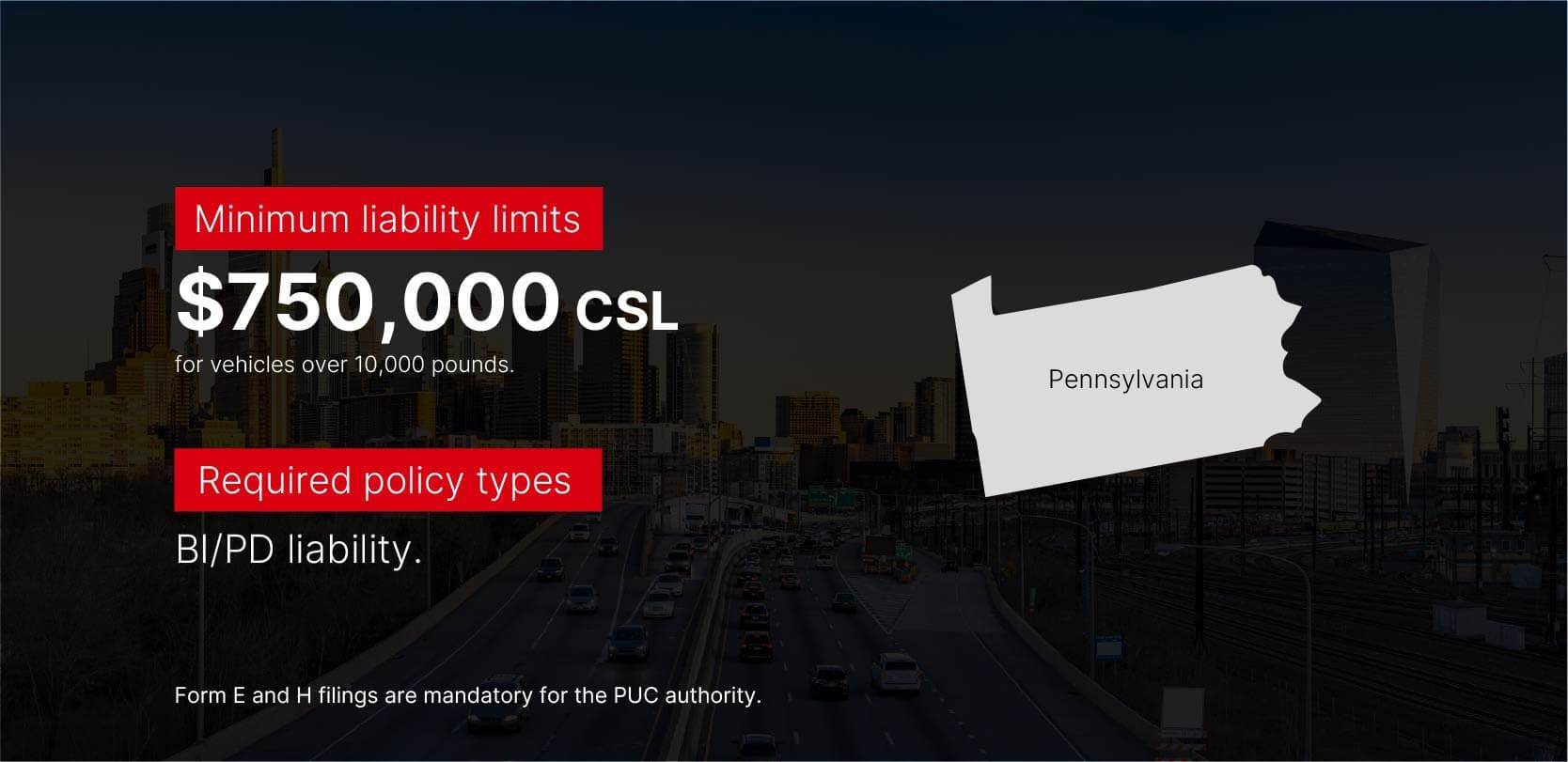
- Minimum liability limits: $750,000 for vehicles over 10,000 pounds.
- Required policy types: BI/PD liability.
Rhode Island
The Rhode Island Division of Public Utilities and Carriers (DPUC) oversees all for-hire intrastate transportation. It ensures carriers get proper licensure and keep continuous insurance coverage.
- Minimum liability limits: Follows federal minimums at $750,000 CSL for property carriers.
- Required policy types: BI/PD liability.
South Carolina
The Office of Regulatory Staff (ORS) requires for-hire carriers to file proof of insurance. This is to obtain a Certificate of Public Convenience and Necessity.
- Minimum liability limits: Aligns with federal standards, requiring $750,000 CSL for most property carriers.
- Required policy types: BI/PD liability and cargo insurance, or Form H.
South Dakota
South Dakota’s administrative rules require motor carriers of property to file and maintain proof of insurance with the Public Utilities Commission.
- Minimum liability limits: Follows federal minimums, typically $750,000 CSL.
- Required policy types: BI/PD liability and cargo insurance.
Tennessee
The Tennessee Department of Revenue requires for-hire carriers applying for intrastate authority to file proof of insurance using specific state-accepted forms, including Form E/H.
- Minimum liability limits: Adopts federal guidelines, requiring $750,000 CSL for most commercial carriers.
- Required policy types: BI/PD liability and cargo insurance.
Texas
The Texas DMV requires intrastate motor carriers to file and maintain evidence of insurance to keep their TxDMV Certificate Number active. This involves filing Form E.
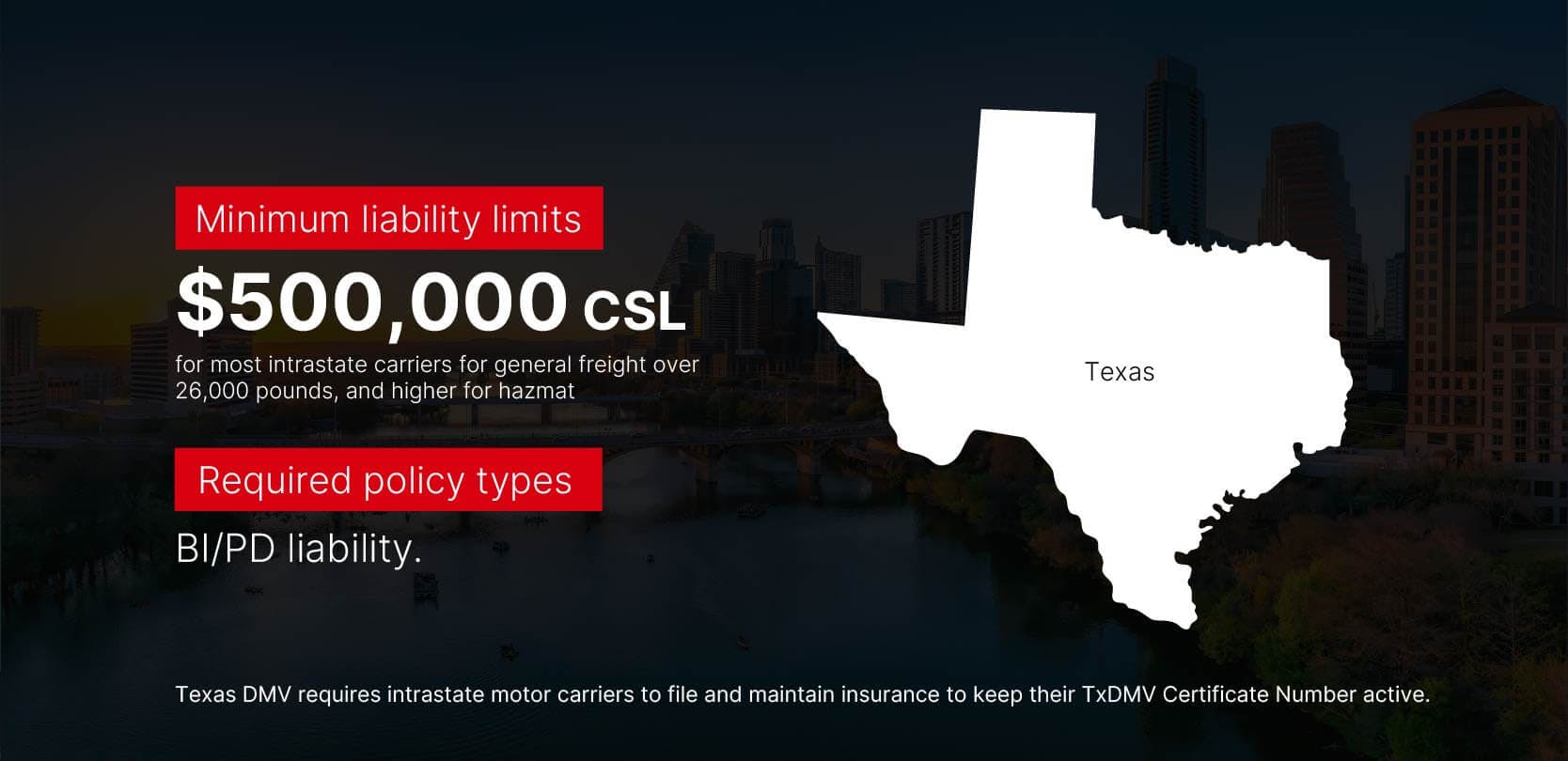
- Minimum liability limits: Texas has a state-mandated minimum of $500,000 CSL for most intrastate carriers for general freight over 26,000 pounds, and higher for hazmat. However, this is the legal minimum for work performed only within Texas.
- Required policy types: BI/PD liability.
Utah
The Utah DOT provides clear guidelines adopting the federal code 49 CFR 387. All carriers must meet these standards for public liability.
- Minimum liability limits: $750,000 CSL for property carriers with nonhazardous goods and vehicles over 10,001 pounds.
- Required policy types: BI/PD liability.
Vermont
Vermont’s financial responsibility laws under Title 23, Chapter 11, form the basis for insurance requirements. The DMV enforces these rules for all registered vehicles.
- Minimum liability limits: For-hire commercial carriers follow the federal standard of $750,000 CSL.
- Required policy types: BI/PD liability.
Virginia
The Virginia DMV requires for-hire carriers to keep proof of insurance on file to maintain their intrastate operating authority. Specific amounts are based on authority type.
- Minimum liability limits: Varies, but generally aligns with the $750,000 federal minimum for property carriers.
- Required policy types: BI/PD liability and Cargo for household goods.
Washington
The Utilities and Transportation Commission (UTC) requires for-hire carriers to have a permit. It mandates filing and maintaining proof of continuous insurance coverage.
- Minimum liability limits: Adopts federal standards, requiring $750,000 CSL for general freight.
- Required policy types: BI/PD liability.
West Virginia
The Public Service Commission’s Code of State Rules, Title 150, Series 9, governs motor carriers. This includes the mandatory filing of evidence of financial responsibility.
- Minimum liability limits: Follows federal minimums, typically $750,000 CSL for property carriers.
- Required policy types: BI/PD liability.
Wisconsin
The Wisconsin DOT requires all for-hire carriers to file proof of liability insurance before operating. Lapses in coverage can result in registration suspension.
- Minimum liability limits: $750,000 CSL, adopting the federal standard for most for-hire trucking operations.
- Required policy types: BI/PD liability or Form E filing.
Wyoming
The Wyoming Highway Patrol enforces the state’s motor carrier rules, which include a specific chapter detailing insurance requirements for all commercial carriers.
- Minimum liability limits: Aligns with federal standards, requiring $750,000 CSL for general freight.
- Required policy types: BI/PD liability.
Get compliant, then get to work with Truckstop.com
Understanding carrier insurance requirements by state is a critical first step toward running legally and protecting your business. Once your liability limits are in place, filings are complete, and your coverage meets both federal and state rules, you’re ready for the next move: getting on the road and booking freight.
That’s where the Truckstop.com load board comes in. With an easy-to-use platform built for carriers, you can search loads, evaluate lanes, and find opportunities that match your equipment and operating preferences. No extra complexity. Just the tools you need to find your first load — or your next one — with confidence.
Get your insurance squared away, then put it to work. Explore the Truckstop.com load board and start hauling.



Get helpful content delivered to your inbox.
Sign up today.
Find high-quality loads fast, get higher rates on every haul, and access tools that make your job easier at every turn.






.png)

.png)

