

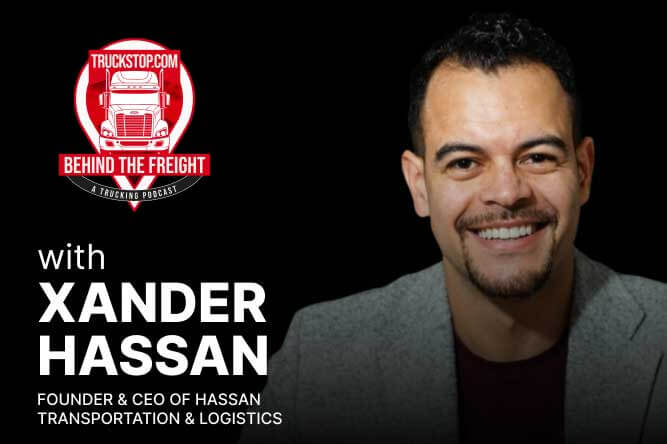
How a lean 3PL uses hospitality and AI to move freight (with Xander Hassan)
Tune in to
Behind the Freight
Real-world knowledge that keeps you in the money.
A brand ships its earbuds in a box built for something twice the size. Every parcel costs a few dollars more than it should. Nobody inside the company flags it, because the packaging has always looked that way.
Most providers never check the box. Xander Hassan builds his whole pitch around checking it.
On a recent episode of Behind the Freight, John Howland and Scott Feather sat down with Xander Hassan, founder and CEO of Hassan Transportation Logistics (HTL).
HTL is a lean 3PL that runs transportation, warehousing, and fulfillment for its customers, with a two-person team doing the work of a much larger shop.
His background is not what you would expect from a freight operator. Six years in hotels shaped how he treats shippers, and a stack of AI tools now handles the parts of the job he used to lose hours to.
How Hassan Transportation Logistics got started
Xander spent six years at Marriott before freight, working up from pool boy and valet to Director of Front Office in Charlotte. When COVID cut most hotel jobs, a friend at Total Quality Logistics told him he would be good at freight.
A manager hired him for a “get it done” attitude, and the first stretch was rough. He made 70 calls a day for 60 days straight before a single callback came in. One of those callbacks turned into moving structural steel for the escalator stairs at SoFi Stadium, a project he ran during his TQL years.
A few years later, Xander started his LLC, and called an old contact who was ready to sign. Getting his own broker authority cleared the way, and from there he hammered the phones again.
That grind is still how HTL runs today: put in the unglamorous work first, and the bigger freight follows. It’s the same patience hospitality had already taught him, long before freight did.
The hospitality mindset behind the brokerage
The habit that carried over from hotels is anticipation. At the front desk, you refill a guest’s glass before they ask. On a dock, you send a liftgate before the driver calls to say there isn’t one.
The same thinking shapes how he prices. Xander will take a load at a thin margin to keep a customer moving, betting that reliable service today brings the next load tomorrow. He describes HTL as “the shipping company people don’t realize they need yet,” and leans on service quality as the way a small shop can stand out from bigger brokerages.
“Even if I don’t make a margin on a truck, I’ll book it to get it moving because customer retention guarantees future loads.”
Using AI to win back the day
The back-office work is where most of his hours used to go. Now AI runs his QuickBooks, lead tracking, P&Ls, and accounting, then hands him reports to confirm. Letting a tool handle the repetitive back-office tasks is what frees him up to sell and service accounts.
He also points AI at his own network. Using tools like Claude, he reviews his LinkedIn connections, builds profiles of warm introduction candidates, and researches a person’s background before a call. Over two weeks, that approach generated 12 to 15 meetings and three solid leads, a pattern that matches how brokers are starting to use AI for a first pass on routine work.
His rule for any of it is to treat the tool like a new hire that needs training before you trust the output.
“Gaining two hours back every day allows me to prospect new clients or ensure current customer performance is flawless.”
Finding savings most providers miss
Xander’s edge is dimensions. He runs the numbers on a prospect’s packaging and shows them what a smaller box would save, and the savings add up fast. In one example he shared, shrinking a box by two inches saved a client $4 per parcel, which comes to nearly $800,000 a month across 199,000 parcels.
The same eye applies to consolidation. He is pushing HTL toward e-commerce, parcel, and LTL consolidation, and pairing transport with the warehousing and fulfillment work a 3PL handles so a shipper can pre-stage inventory instead of paying full line-haul every time.
Carrier evaluation, theft, and earning trust
Not every story is a win. Xander had two trucks stolen on separate occasions while posting loads, and in his telling, small operators are the target. He spent two months tracking one truck to Mexico and found the other in Southern California, and in the end nothing was taken.
“Cargo thieves target small brokers thinking they aren’t paying attention.”
The experience hardened his view on vetting. He expects strict carrier vetting on both sides, especially with the FMCSA weighing broker liability, and he keeps a short list of go-to carriers he trusts and keeps busy. For a small brokerage, staying alert to freight fraud is part of protecting both the customer and the authority.
What a resilient brokerage really comes down to
Xander’s approach is a simple order of operations: anticipate what the customer needs, let AI clear the busywork, and put the reclaimed time back into service and vetting. A two-person shop can compete with the giants when it treats every account like the only one.
Start with one workflow this week. Pick the task that eats the most time, hand the first pass to a tool, and spend the hour you save on a customer call.
Truckstop tools work the same way, surfacing carrier history, rate data, and risk signals so brokers and carriers can act faster and reduce surprises before booking.
Listen to the full episode for more from Xander on hospitality, AI, and building a lean 3PL.




Get helpful content delivered to your inbox.
Sign up today.
Find high-quality loads fast, get higher rates on every haul, and access tools that make your job easier at every turn.






.png)

.png)

